
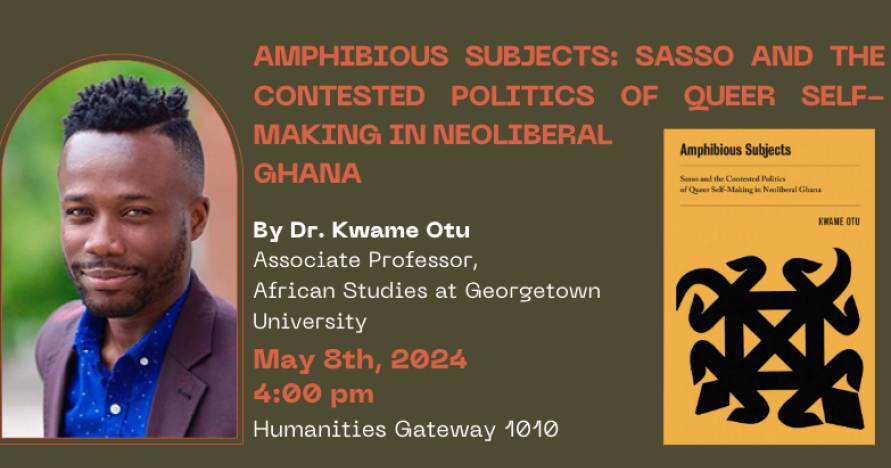
Dr. Kwame Otu (Georgetown), Amphibious Subjects: Sasso and the Contested Politics of Queer Self-Making in Neoliberal Ghana
This section contains archived content made available for reference, research, or recordkeeping purposes. These materials are not actively maintained and may not meet current accessibility standards, such as WCAG 2.1 Level AA. If you need assistance accessing this content or require an accessible format, please contact sohwebmaster@uci.edu. We are committed to ensuring access for all users and will provide accommodations promptly upon request.
Abstract:
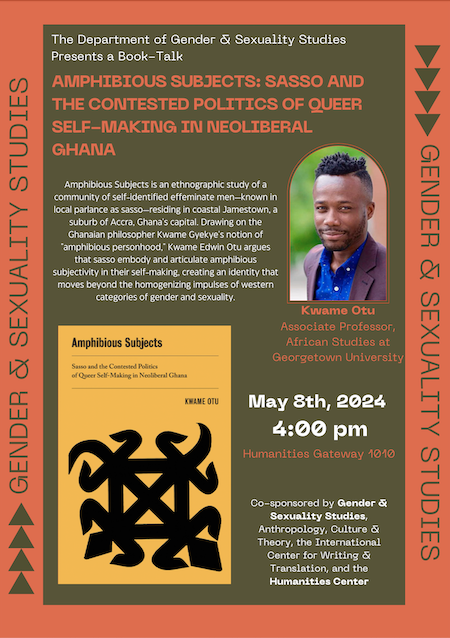
Amphibious Subjects is an ethnographic study of a community of self-identified effeminate men—known in local parlance as sasso—residing in coastal Jamestown, a suburb of Accra, Ghana's capital. Drawing on the Ghanaian philosopher Kwame Gyekye's notion of "amphibious personhood," Kwame Edwin Otu argues that sasso embody and articulate amphibious subjectivity in their self-making, creating an identity that moves beyond the homogenizing impulses of western categories of gender and sexuality. Such subjectivity simultaneously unsettles claims purported by the Christian heteronationalist state and LGBT+ human rights organizations that Ghana is predominantly heterosexual or homophobic. Weaving together personal interactions with sasso, participant observation, autoethnography, archival sources, essays from African and African-diasporic literature, and critical analyses of documentaries such as the BBC's The World’s Worst Place to Be Gay, Amphibious Subjects is an ethnographic meditation on how Africa is configured as the "heart of homophobic darkness" in transnational LGBT+ human rights imaginaries.