
An artist’s homecoming
By Nikki Babri
Most people walk into an art gallery expecting a hushed, library-like space, not a turntable inviting them to drop the needle. Two exhibitions of Compton-born painter Reggie Burrows Hodges, curated by Bridget R. Cooks, UC Irvine Chancellor’s Fellow and professor of African American studies and art history, offer something livelier, displaying his paintings alongside a soundtrack of his own Jamaican-style dub music.
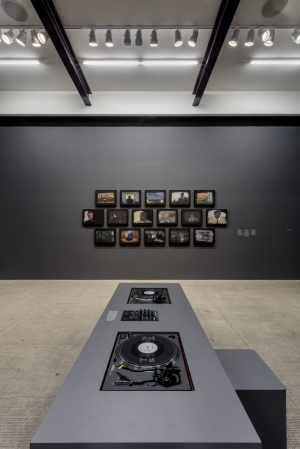
“A Theater of Miracles” at the California African American Museum (CAAM) and “A Theater of Dreams” at Art + Practice in Leimert Park are two parts of an unprecedented collaboration among three Los Angeles institutions. A third exhibition of Hodges’ work, “A Theater of Passions,” was curated by Davide Gasparotto, senior curator of paintings at the Getty Museum. Together, these exhibitions mark Hodges’ first solo museum presentations in his hometown.
“I keep saying it’s a Reggie takeover of L.A.,” Cooks told visitors during a walkthrough at Art + Practice. The experience of each show is different, as are the audiences in attendance. She finds particular value in the partnership’s ability to bring together groups of people that rarely overlap.
“Getty visitors are not necessarily CAAM visitors or Art + Practice visitors,” she explains. “This is an opportunity for people to feel like there is something for them in each of those places.”
Old Masters, new rhythms
Cooks, who has curated two previous exhibitions at CAAM, was invited to join the project by Executive Director, Cameron Shaw. When she first saw Hodges’ paintings two years ago, she was struck by the influence of the Old Masters, the prominent European painters who worked before 1800, many of them represented in the Getty’s collection.
Now 60 and based in the Bay Area, Hodges committed to painting relatively later in life after years of teaching animation, filmmaking and theater and touring with his reggae-dub band, Trumystic. Cooks calls him “a mysterious kind of Renaissance man,” and made it a priority to bring his music into the galleries alongside his paintings.
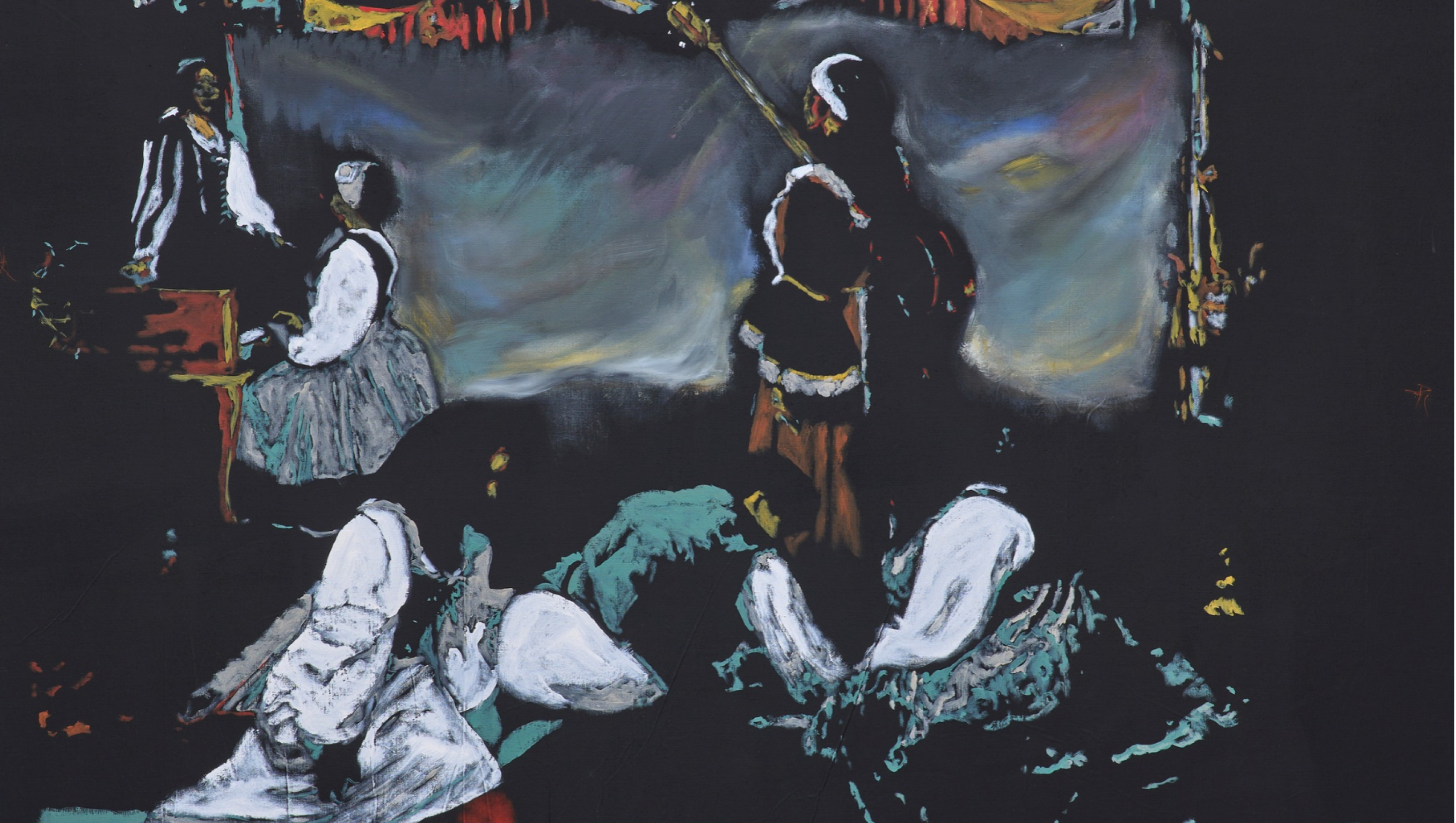
The influence of the Old Masters shows most clearly in Hodges’ compositions. At CAAM, Cooks hung Jacopo Bassano’s “The Miracle of the Quails” (1554), on loan from the Getty, beside Hodges’ “The Agreement We Rely on: Helen’s Birdcage” (2023), the painting it inspired and the only side-by-side pairing across the three shows.
“At first you may want to go back and forth, to compare the paintings to see how Reggie is working with the painting,” she says. “And then immediately you get swept away with what he’s created. His practice is not about mimesis. He’s not trying to make a faithful reproduction.” Instead, staying true to his musical background, Hodges fills Bassano’s scene with music, adding a figure holding a bass and another seated at a piano, as if about to play.
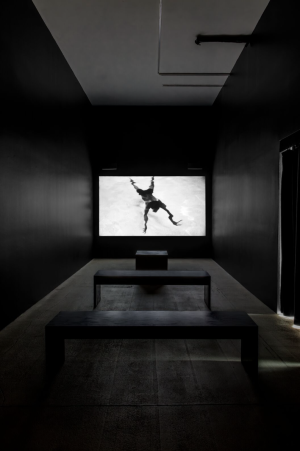
At Art + Practice, a short film shows Hodges sketching live models – a practice Cooks points out is a tradition from the Old Masters – set to a score of his original music. For her, the unexpected pairing of old and new is what makes the gallery so enticing.
“In my experience, the music and the models help close a gap between previous centuries and the contemporary work Reggie has made,” she says. “I think it might encourage people to consider how these older paintings can be resources, how they can be relevant to the way we think about painting today, but also the way we might understand situations we’re in now.”
Giving form to blackness
Most of Hodges’ paintings begin with a linen surface painted entirely in black. Scenes come to life around this background, but he never fully paints over it. “If we look at the plane or the figure, we can see how the black background becomes the object itself,” Cooks explains, “making the negative space positive.”
Many of his figures are left without facial features, their faces the same black as the background. “Because many of the figures’ faces are black,” Cooks says, “we can think about these folks as Black people, but also as universal, which may make it easier for some people to identify with them.”
That ambiguity is on full display in “Public Notice” (2023-24), one of Cooks’ favorites, which she hung between theatrical curtains at Art + Practice. Its three faceless portraits, each inspired by a different Getty painting, paired with its puzzling title, leave viewers with more questions than answers. “It’s a really intriguing painting to look at and wonder: who are these people?” Cooks asks. “Why does the public need to be notified about them? Are they criminals? Are they running for office?”
The memories of home
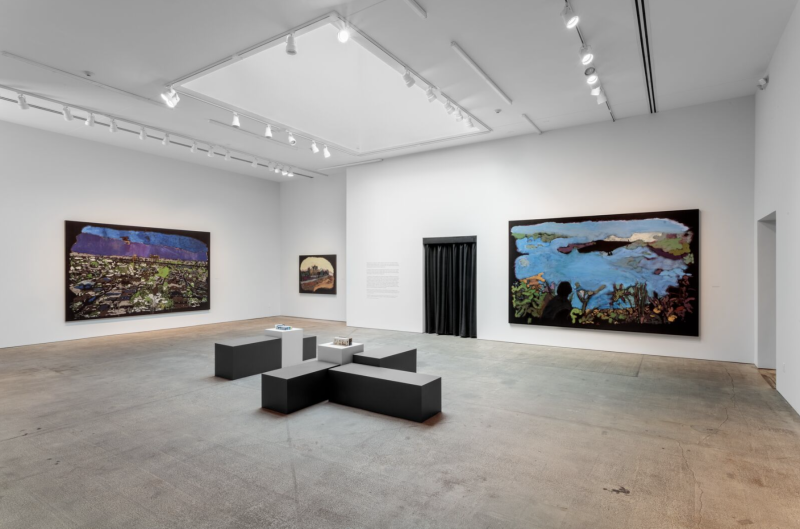
Each exhibition title begins with “A Theater of,” a nod to the high drama of the Baroque paintings that shape so much of Hodges’ work. He made four paintings specifically for Art + Practice, each roughly seven by 12 feet and inspired by his childhood in Compton.
Because Hodges paints on unstretched linen and ships his canvases rolled, he saw them stretched and framed for the first time when he met Cooks at the gallery. “He walked into Art + Practice, walked toward the gallery, and said, ‘They’re so big,’” she recalls. “There’s something about the size of the paintings in that room that makes it so immersive, almost like you can walk into the paintings.”
During one walkthrough, a visitor from Compton stood before “Shadow Swing” (2026) and immediately recognized the green spaces where neighbors had gathered when she was a kid. “I experience the painting as very gestural and abstract,” Cooks says. “But she had a particular memory wash over her, and she was so grateful for it.”
The gallery also features a mini theater and shelves of books Hodges selected that include everything from comic books and Toni Morrison to Rembrandt and James Baldwin. The second gallery, which turns to Hodges’ travels through Europe and his responses to the Getty collection, includes two turntables and a yardie-style sound system. Again, Hodges’ music is offered for visitors to play along with a selection of his favorite albums.
Cooks sees the two gallery rooms as a journey to understanding that home is a foundation for seeing the world. “In gallery one, we can think of home as a place where those dreams really begin, and then in gallery two you see a fulfillment of those dreams, the grand tour of the artist going through Europe,” she says. “And the luxury to look back, to remember your childhood fondly and make these beautiful paintings.”
An open invitation
Cooks has taught for 26 years at UC Irvine, and curating was not always a part of her career. However, it’s the collaboration that excites her, which makes working with a living artist especially rewarding. She ran each curatorial idea past Hodges before bringing it to the museums and found him to be an enthusiastic partner. “He’s someone who is excited to have another brain, with its own ideas and experiences,” she says.
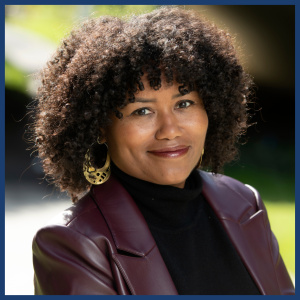
She is collaborating again on her next exhibition, a 2029 retrospective of the late UCI artist and professor Yong Soon Min, co-curated with Kylie Ching ‘23 (Ph.D. visual studies), a former student and now assistant professor of art history at Cal State Fullerton. Cooks is also editing a volume of writings by her UCI predecessor, Judith Wilson, and her exhibition “Repossessions,” which originally debuted at CAAM, travels from the Harvey B. Gantt Center for African-American Arts + Culture in North Carolina to Minnesota’s Macalester College next year.
Public-facing exhibitions like these are a welcome change from her usual work. “Mostly what I do is write in silence by myself, and that’s how you get things done,” she says. “But it is fun when you have a very visible moment that people can actually experience and walk into.”
She hopes that includes people who might not normally visit. The city’s art scene, she notes, is far bigger than most people realize. “I’d love for people to start thinking about all the incredible resources we have, even just in Los Angeles,” Cooks says. “Maybe there’s a type of artwork, gallery or museum you don’t go to because you think it isn’t your thing. Going to a new art space is an act of opening your mind, expanding your horizons. That’s something we should all be doing.”
All exhibitions are on view through February 2027. A catalogue featuring essays by Cooks and Gasparotto will be published in Spring 2027.
(Main image: Reggie Burrows Hodges, The Agreement We Rely On: Helen’s Birdcage (2023) Acrylic and pastel on linen. 61 ½ x 87 in. Courtesy of the Artist and Karma.)
Interested in reading more from the School of Humanities? Sign up for our monthly newsletter.