
Revisiting the Past on the Page and in Museums: A Day of Discussion Featuring Historians, a Curator, and a Novelist
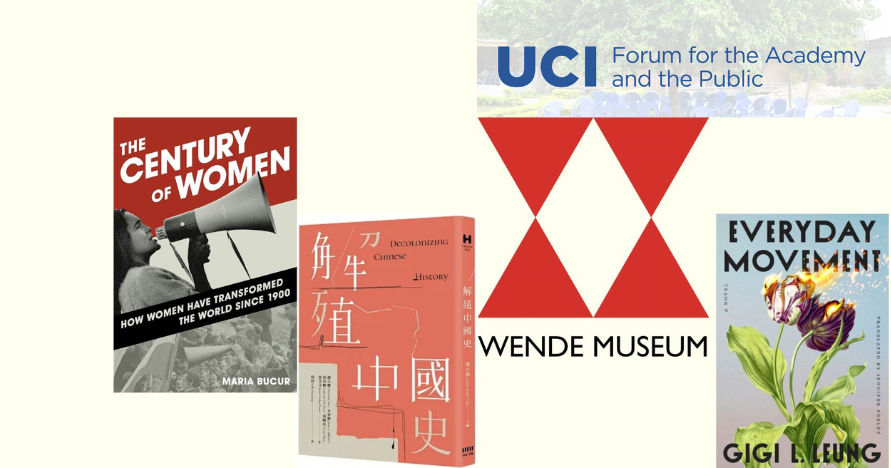
How have historians been developing narratives that take novel approaches to standard chronologies of major global and national events? How do museums and novels engage in parallel forms of reworking stories of the past? This one day symposium organized by the UCI Forum for the Academy and the Public will explore these questions via presentations by a leading specialist in European history (Maria Bucur of Indiana University) and a leading specialist in Asian history (James Millward of Georgetown University); a luncheon workshop featuring a curator (Joes Segal of the Wende Museum); and an evening book talk by a novelist based in Taiwan who writes about her native Hong Kong (Gigi Leung) and the translator of her acclaimed novel Everyday Movement (Jennifer Feeley). The symposium, which will include various scholars from UCI and other local campuses acting as commentators and facilitators of discussion, will be part of the yearlong "Storytelling, Truthtelling" program of the UCI Humanities Center.
This event is sponsored by the Forum, a joint enterprise of the Schools of Humanities and Law with close ties to the Department of History and the Literary Journalism Program. Additional support for this event comes from the following UCI co-sponsors: the Long Institute for U.S.-China, the Global Asias Research Cluster, the International Center for Writing and Translation, and the Center for Storytelling. Special thanks to the Taiwan Academy in Los Angeles for supporting Leung and Feeley's visit and the Wende Museum in Culver City.
All events are in HG 1030. For questions, contact SueJeanne Koh at sj.koh@uci.edu.
Joes Segal, Curator of Wende Museum
Choi Chatterjee, Emerita Professor of History, California State University, Los Angeles
Jeff Wasserstrom, Distinguished Professor of History, UC Irvine
Register by Oct. 8th for the luncheon at this form, a collaboration with the Humanities Center on their annual theme, "Storytelling, Truthtelling."
4:00 PM - 5:15 PM
"Structuring Chinese History: Diwang tu 帝王图, Nianbiao 年表, 'Chinese Dynasties' Charts, and Paradigmatic Crisis in Chinese Historiography"
Jim Millward, Professor of History, Georgetown University with comments by Micah Muscolino, Professor of History, UC San Diego
Periodization by "Chinese dynasties" is a structural foundation of the historiography of continental eastern Eurasia, but even those passingly familiar with the field know the idea is beset with problems: The Chinese dynasties aren't all "Chinese." They weren't all in the same place, but were scattered around geographical China and Inner Asia, often two or more at the same time. What we call "dynasties" go by many names in Chinese (what's the difference between a chao, a dai and a guo?). And no one can tell you exactly how many "Chinese dynasties" there were. Despite these issues, the modern list of "dynasties" is central to the notion of a unified, linear and continuous "China" that is said to be the "oldest civilization in the form of a state in the world." This lecture examines charts and tables of monarchs and polities from Sinitic and European traditions to scrutinize dynasties periodization as a translingual practice. It will argue that Sinitic efforts to periodize were linear and progressive, not cyclical; always discursive rather than canonical; and that the list of so-called "Chinese dynasties" changed with political winds and trends in historical philosophy.
Contact: Emily Baum, emily.baum@uci.edu. Co-sponsored by the UCI Long U.S.-China Institute