
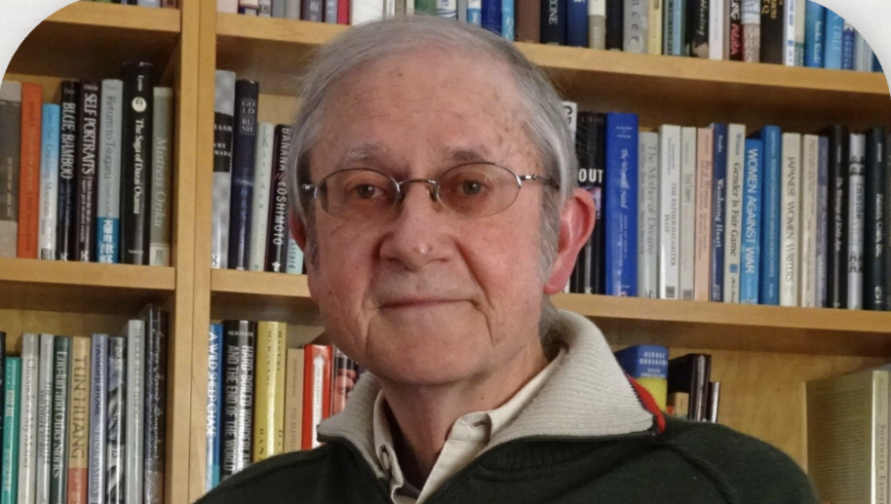
In Loving Memory of Ted Fowler
Remembering Ted Fowler
Edward “Ted” Fowler (1947-2026), Professor Emeritus of East Asian Studies at the University of California, Irvine, passed away on the morning of September 24, 2026. Born in 1947 in Salt Lake City and raised in Monrovia, at the foothills of the San Gabriel Mountains, he graduated from Pomona College in 1969, studied Japanese at the Stanford Inter-University Center, earned his M.A. in Japanese Literature from The University of Michigan, and received his Ph.D. in Modern Japanese Literature from UC Berkeley in 1981. He joined the faculty at Duke University where he became tenured, before accepting a position at UC Irvine in the fall of 1991 where he would teach and serve as department chair from 2004 to 2008. He retired in 2013. His academic achievements which supported his remarkable career started with a Phi Beta Kappa at Pomona College in 1969, a Fulbright award (89-90), Japan Foundation Fellowship (2002) and a Guggenheim Fellowship in Creative Arts (2008-09). Continuing to work well into his retirement years, he was a finalist for the 2019 San Francisco Writers Conference Writing Contest for his non-fiction manuscript Rights of Passage.
During the formative years of Japanese modern nationhood, the creation of a prose narrative similar to Western European standards of verisimilitude became the touchstone to which writers in Japan aspired, and by the early twentieth century, the confessional or I-novel quickly became its standard bearer. In an academic career that rejected the promised security of affiliation with a school, important canonical writer, or critical fashion, Ted’s prize-winning study (Philip E. Lilienthal and Hiromi Arisawa Prizes, 1989, 90), The Rhetoric of Confession, helped rescue the shishosetsu (I-novel) from mind-numbing iterations of debates on realism and from its uses in affirming a Japanese cultural exceptionalism. Eschewing the emerging fanfare surrounding theory at the time while deftly employing its insights, Ted produced, in his own words, “a study of the fictionality of autobiographical narrative in early 20th-century Japan.” Although the book was not translated into Japanese, as would have befitted its landmark status in rethinking Japanese letters, chapters 4, 5 and 6 appeared in Japanese translation in important academic journals (Kaishakugaku, Waseda bungaku, and Chikamatsu shuko kenkyu).
Both as the subject of critical inquiry and as practice, Ted maintained an unflagging interest in translation. His influential essay, “Rendering Words, Traversing Cultures: On the Art and Politics of Translating Japanese Literature,” led to exchanges beyond the essay itself with the combative Chalmers Johnson, and it would effectively provide a theoretical framework for several scholars to refuse participation in the latter’s Great Books of Japan (Nihon no meicho), modeled after Great Books of the Western World. His translation of the book, A Man with No Talents: Memoirs of a Tokyo Day Laborer (San’ya gakeppuchi nikki) by Oyama Shiro, would supplement his own study of San’ya. Among his prominent translations are essays by Maeda Ai, “Their Time as Children: A Study of Higuchi Ichiyo’s Growing Up,” along with “Asakusa as Theater: Kawabata Yasunari’s Crimson Gang of Asakusa,” short stories by Tamura Toshiko, “Lifeblood” (Ikichi), and “The Vow” (Chikai), Shiga Naoya’s “Dwelling by the Moat” (Horibata no sumai) and many others. In a hard-hitting review essay, “On Naturalizing and Making Strange: Japanese Literature in Translation,” (Journal of Japanese Studies, 1990) Ted took issue with what he viewed as the domestication and exoticization of Japanese literature by translators and publishers who, he argued persuasively, had contributed to the creation of a false canon.
The role thrust upon every thoughtful Japan-studies scholar--namely, to undo the damage done by the Western press, such as The New York Times and others, in misrepresenting and commodifying Japan--was one that Ted took seriously. His approach to appropriately defamiliarizing Japan came through a dedicated identification and concern with Japan’s underclass, the sacrificial unseen that underwrote the storylines of economic, industrial, and more recently, subcultural achievement. His astonishing first-person account of the day laborer community in Tokyo, San’ya Blues: Laboring Life in Contemporary Tokyo (1996), starkly unveiled the shameless exploitation of day laborers as the enabling agent of Japan’s high-growth era and beyond. What probably surprised us most as colleagues in text-based fields like literature, history, or visual arts, is how he embodied the hard physical realities of brutal and unfair extraction of labor, and did so with a vividness that obviated the need to provide any longwinded indictments of such endemic exploitation. His abiding interest in the dispossessed resulted in his prize-winning (Japan-US Friendship Commission Award) translation mentioned above of A Man with No Talents, studies of buraku literature and society, including “Making Up Race: Notes on Buraku Literature in Japan,” “The Buraku in Modern Japanese Literature: Texts and Contexts,” “Minorities in a ‘Homogeneous’ State: The Case of Japan,” and many other essays, translations and miscellaneous writings.
Over the years, Ted helped maintain an intimate relationship to Japan by regularly publishing essays in Japanese magazines, a feat requiring a level of command of the Japanese language rarely attained by Western scholars of Japan. These works cover a staggering range of subjects that often had a way of jolting his Japanese readers into reflecting on their own culture that they suddenly weren’t so sure they knew all that well. Sata Ineko’s essay, “My Map of Tokyo,” was playfully appropriated by Ted in his “My Map of Tokyo’s Toilets,” which he claimed, not entirely tongue-in-cheek, was a necessity for exploring Tokyo for anyone with delicate plumbing. Other essays, like “Tokyo Bura-Ted” (Tokyo Strolls with Ted), took TV personality Tamori’s discovery program “Bura-Tamori” as a cue for his own learned encounters with oddities and surprising discoveries in the city.
Through the protean richness of his achievements as an intellectual runs an insistent concern for the space where literature, or anything else, happens. His students were captivated by the ground-level optics that he frequently brought to his accounts of Japan, whether it be a scene from Soseki’s novel, the gritty particulars of backbreaking labor depicted in San’ya Blues, or his personal encounters with writer Murakami Haruki. (Murakami would later recall that one of his fondest memories of his one-quarter residency at UCI was visiting with Ted.) Whenever possible, Ted would make a point of walking and interacting in that depicted space. Japanese letters have a distinguished legacy of ‘reading place,’ from urban ethnographers like Kon Wajiro and Gonda Yasunosuke, to literary scholars like Maeda Ai. Ted would let a deliberate walk reveal the simple but unseen things that gave shape to works we yielded too habitually to broad optics, our preconceptions or theory to explain. There is a scene in the proletarian writer Tokunaga Sunao’s City Without Sunlight in the lowlands abutting what is today Koishikawa Botanical Gardens in the heart of Tokyo where the emperor of Japan arrives on horseback to survey the landscape that extends below. His panoptic view cannot take in the pockets of slums that occupy the shaded lowlands where the low paid print factory workers live. “We have to walk this area,” Ted said without hesitation, to make sense of where the topographical crenelations separated row houses from industrial pockets, where little streams that had long been diverted underground had traversed, and to get an immediate sense of the actual dimensions of observable and hidden lands in the compass of the imperial gaze of a kilometer or two—because none of these things that happen, or that topography enables or prevents, could be properly understood without being there, following the curves and barriers of the land.
Ted would come to know Tokyo better than almost anyone in Japan. He could often be seen leading individuals or groups of scholars, graduate students, or friends who happened to be in Tokyo, on behind-the-scenes tours of Asakusa’s Sensoji Temple or the remarkable Mikawashima Water Reclamation Center in Arakawa Ward. He had a way of elevating walking into a graceful art form, which he did with the same energy and insouciance of youth that, many decades earlier, had led him to scale Mt. Baldy, the holy grail of every serious hiker in Southern California, as if it were a walk in the park.
Ted is survived by his wife, Yukari Fowler, his sister Lisa Fowler, son Eugene Fowler and his wife Pauline. He also leaves behind his three cherished grandchildren Liam, Chloe, and Luke, along with several generations of appreciative graduate and undergraduate students. He was predeceased by his teacher and friend, Professor William Sibley, whose lifelong relationship as his mentor deserves mention.
Written by James Fujii, on behalf of the Department of East Asian Studies
October 5, 2026