
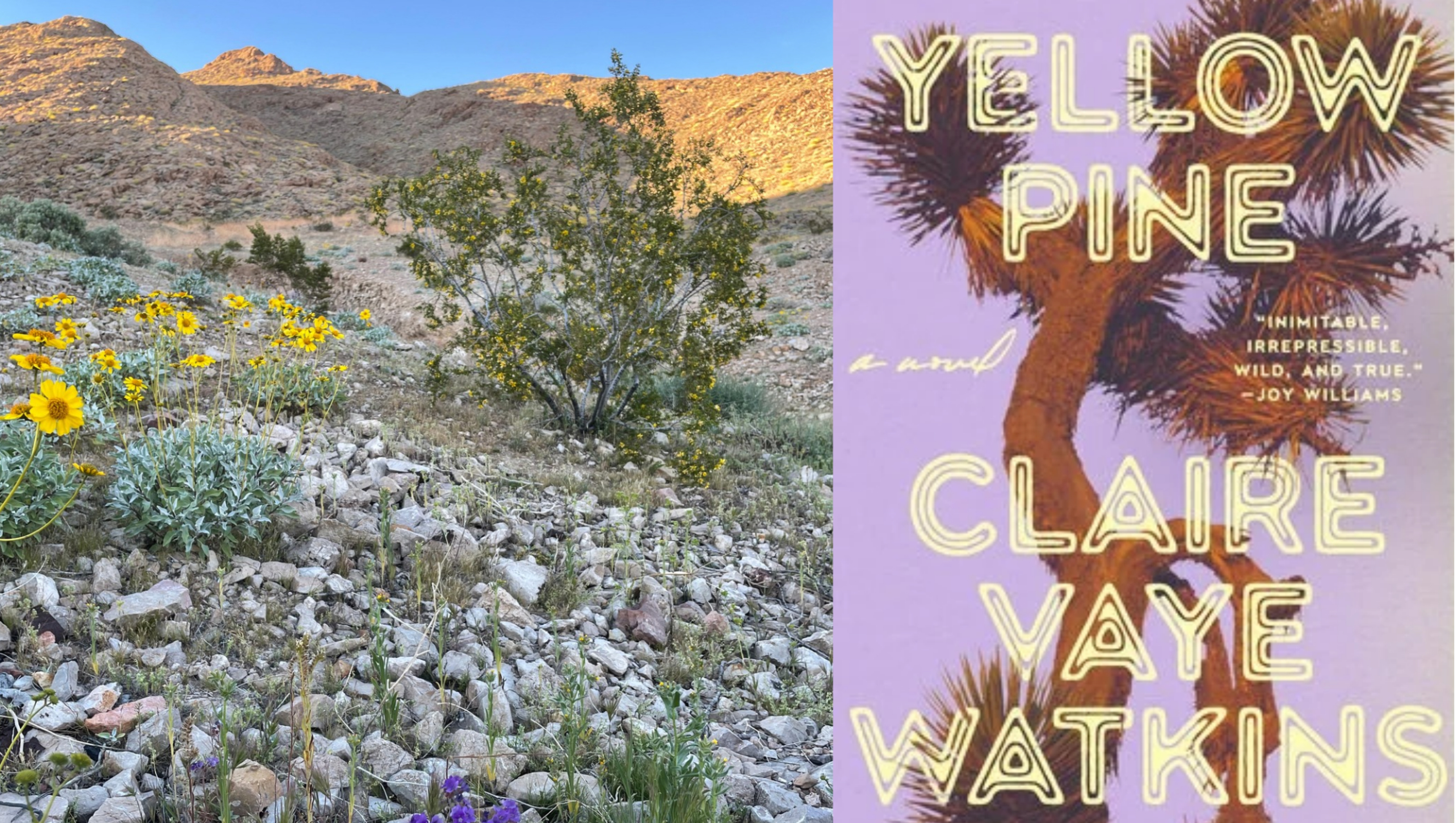
Inspired by the desert
Listen to Claire Vaye Watkins read Chapter 1 of her new novel, Yellow Pine.
By Rebecca Tuhus-Dubrow
A few years ago, Claire Vaye Watkins, a professor in UC Irvine’s MFA Programs in Writing, learned that a huge solar array was under construction in the Mojave Desert not far from her home. Although she supported renewable energy, she was disturbed by the impacts this infrastructure project, dubbed Yellow Pine, would have on the local ecosystem. It would occupy 5,000 acres of formerly public land, and hundreds of endangered tortoises would need to be relocated.
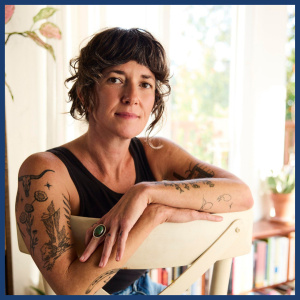
She spent time at the site with activists who were protesting the project. These encounters formed the germ of her new novel, Yellow Pine (Riverhead Books, 2026). Set in a small patch of desert, the novel poses some big questions: about nature, climate change, despair, community and love.
Extremes of emotion
Facing the desecration of the desert was a dark emotional experience, Watkins recalls. But during the same period, she was falling in love. She marveled at the coexistence of these emotions. “That started to feel pretty miraculous to me,” she reflects. “That even though a situation is bad, we are still capable of something as audacious as love.”
The novel’s protagonist is Rose, a woman on the brink of 40 who lives in a cinder-block house she calls Nothingness Flats in Tecopa, California. Her daughter, Juniper, lives with Rose’s ex-husband on the East Coast for most of the year. Rose is employed by the Sierra Club, but she’s on paid leave, pending an investigation of sexual harassment allegations against her boss.
As the novel opens, she is on the verge of rekindling a passionate romance with an old flame named Miles. She also soon starts dropping by the encampment at Yellow Pine and finding a community with the activists, who are led by “an ecofeminist Whitmanic poetess of equine bearing,” as Watkins describes her in the novel.
The novel mostly stays close to Rose’s inner life. She ruminates on the injustices and tragedies of the world today, including climate change, biodiversity loss and the exploitation of the desert. Yet a sharp sense of humor is also in evidence. “She’s a lot like me,” Watkins acknowledges.
Watkins wrestled with the question of how someone who is highly sensitive to all that is wrong in the world can nourish meaningful relationships and live a good life. “I think for a long time I thought that wasn’t really possible,” she says, “and maybe I feared it wasn’t even ethical to do. But I don’t think that anymore.” Rose helped her see that it is not only possible, but might form a foundation for effective activism.
The desert as muse
Watkins grew up in the Mojave Desert, in Southern Nevada, and her writing evinces a love for both the stark beauty of the landscape and the idiosyncrasies of people who inhabit it. When giving Miles directions to her home, Rose pungently evokes the essence of the place: “Pass a bottle house, a bus, a cemetery, a half-burned barn, an art-freak compound. Pass a thicket of cane grass threaded with prickly pear and junk sculptures...”
“The desert is basically my muse,” Watkins says. She is deeply interested in what happens when people are confronted with a vast space that is not designed with their interests in mind, that is not always convenient or comfortable.
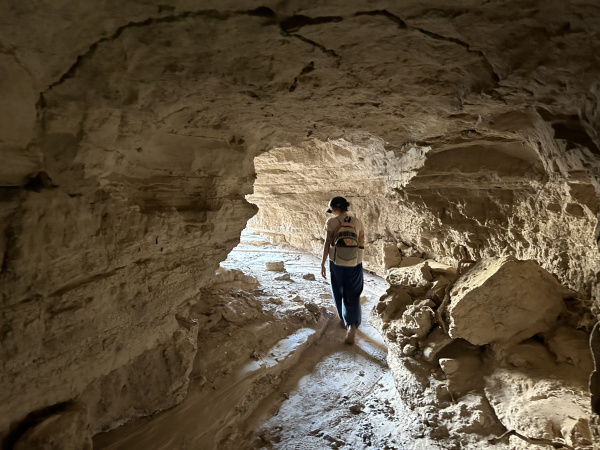
There’s also a long history, Watkins notes, of outsiders who show up and attempt to intervene. It’s common for “some fool to come along and say, ‘Oh, there’s nothing here, so I just get to do whatever I want.’”
That’s what she sees happening with the construction of solar arrays in the desert, which has been called the “green energy gold rush.” She believes solar panels should be installed on rooftops and on land that is already degraded. “I think the choice between decarbonizing the economy and biodiversity is a false choice,” she says.
From theater kid to acclaimed author
Watkins, who joined the UCI faculty in 2020, is the author of three previous critically acclaimed works of fiction: a short story collection, Battleborn (2012), and two novels, Gold Fame Citrus (2015) and I Love You but I’ve Chosen Darkness (2021). She has won the New York Public Library’s Young Lions Fiction Award and a Guggenheim Fellowship, among other honors and awards.
The magic of words has always enchanted her. As a child, she participated in theater, but eventually realized that her favorite part was memorizing lines alone in her room, and “just rolling around in the language.”
She was also a voracious reader. She read the classic Sweet Valley High series, featuring a pair of blond twins, and rewrote them so that the sisters had brown hair. “So, pretty experimental stuff,” she jokes. Later, her inspirations included Joan Didion, Joy Williams, Henry David Thoreau, and Emily Dickinson.
While some novelists focus primarily on plot, Watkins keeps her attention more on the sentence level. When writing, she says, “You have to have faith that one well-crafted sentence after another will build up to something over the arc of it.”
The reception of Yellow Pine suggests that her faith was not misplaced. The New York Times Book Review praised its “passages of gobsmacking beauty” and “desert-dry wit.” Joy Williams called it “Inimitable, irrepressible, wild, and true.” Watkins was also a guest on the national radio program Fresh Air with Terry Gross, a sought-after platform for writers.
Writing fiction as “trying to meet ourselves”
This fall, Watkins will be teaching a course titled “Writing the American West,” which covers place-based fiction and nonfiction, as well as an advanced fiction workshop. In the spring, she’ll teach a fiction workshop for graduate students. As of this quarter, she also serves as director of the MFA program.
“I really like teaching it because there’s so much joy for the students,” she reflects. “Really what we’re doing is trying to meet ourselves. It’s really personal, which is really a wonderful gift. And I think it requires a lot of care.”
She is currently writing a documentary about Yellow Pine. It covers some of the same material as her novel but in the form of a nonfiction film. She is also working on two new novels.
As a faculty member at a university, she is conscious that her modes of research differ from those of most of her colleagues. Writing fiction is a much more oblique way to produce knowledge than, say, inspecting materials in a lab or perusing a spreadsheet. Her research might entail, for example, looking at a tortoise all day, thinking about what she sees, and observing how she feels. “It’s about representing experience, which is really mysterious.”
Rose’s experience in Yellow Pine, while difficult at times, ultimately offers grounds for hope. “It’s okay to despair, but you can also move through despair,” Watkins says. She knows that it can feel almost impossible to look squarely at some of the painful realities of the world today, such as extinction and climate collapse. “But what I’ve found is that we can, especially if we have other people that we’re doing it with.”
Rebecca Tuhus-Dubrow is a writer in residence at UC Irvine's Forum for the Academy and the Public.
Interested in reading more from the School of Humanities? Sign up for our monthly newsletter.