
Critiquing the service sector – and working in it
By Rebecca Tuhus-Dubrow
When she was 19, Annie McClanahan was employed at Heine Brothers Coffee, a local chain in her hometown of Louisville, Kentucky. She knew she was supposed to act cheerful while pulling espresso shots and ringing up customers, but she couldn’t always bring herself to fake it.
One day, she was unceremoniously fired. According to her boss, she didn’t look happy enough.

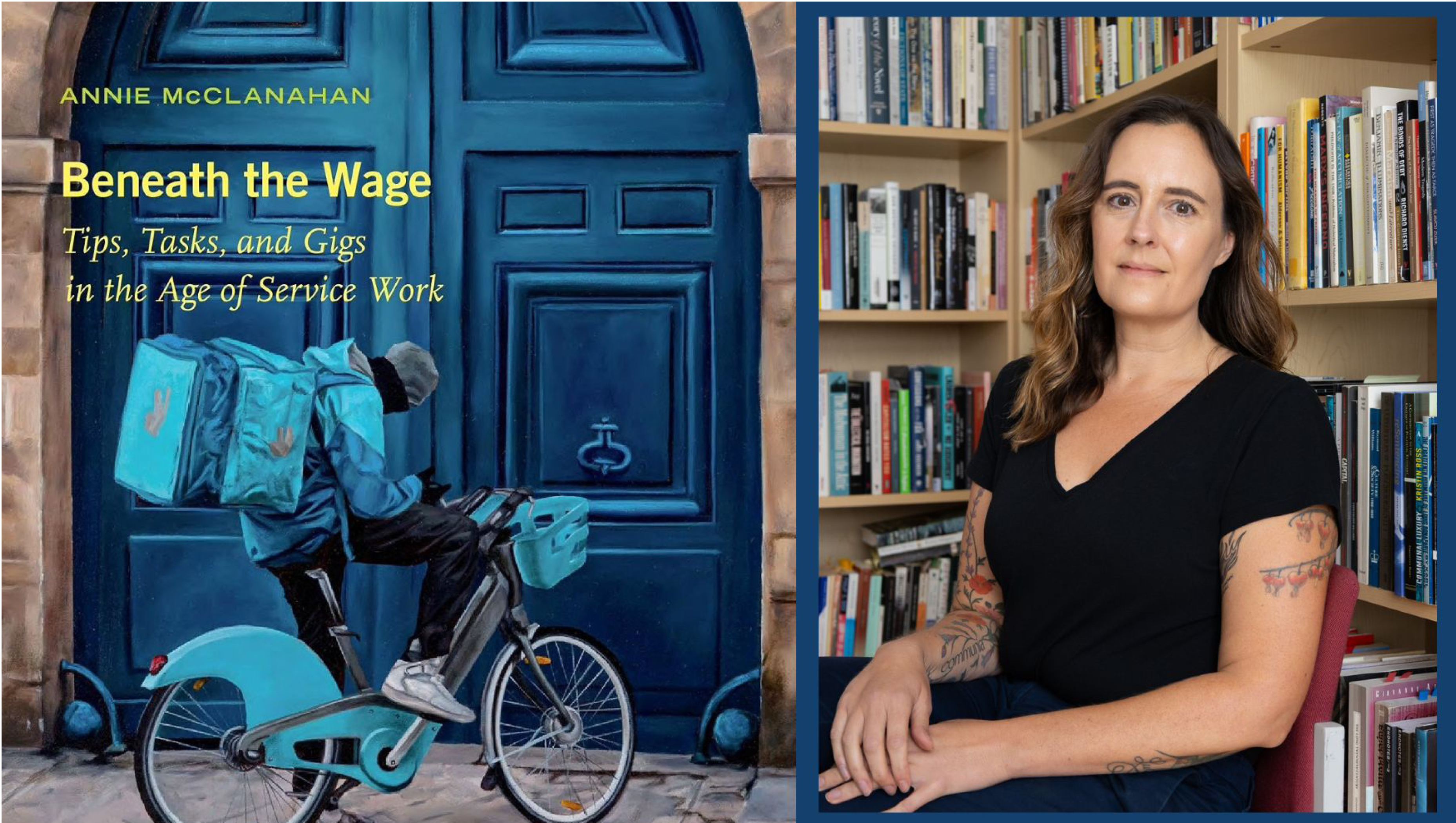
McClanahan is now an English professor at UC Irvine. Her early experience fostered an abiding interest in the service sector. Beneath the Wage: Tips, Tasks, and Gigs in the Age of Service Work (Princeton University Press, 2026), her new book, offers a vivid and thought-provoking portrait of contemporary service work, from restaurant servers to Uber drivers to drug dealers. In the book she argues that technological and economic forces have produced extreme exploitation, but have also opened up possibilities for organizing and solidarity.
From debt to the service sector
McClanahan’s previous book, Dead Pledges: Debt, Crisis, and Twenty-First-Century Culture (Stanford University Press, 2016) explored how American culture responded to the 2008 financial crisis. “I was interested in what happens when such a large percentage of the working and middle class is reliant on debt to make up the gap between low wages and high cost of living,” McClanahan explains.
Beneath the Wage looks at a different angle, asking, “How did we get to a point where there was that gap between wages and cost of living?” McClanahan concludes that one major reason is the reliance of the economy on the service sector – 80% of Americans perform some type of service work – which by nature tends to be lower-waged.
Historically, the working-class norm has been defined as white men working nine-to-five jobs, producing goods for hourly wages. Service work, by contrast, tends to be informal, with less reliable payment and less regular hours. Sometimes it can be emotionally intimate, as in the case of care work. As a result, it has not always been seen as legitimate and deserving of protections. As McClanahan writes, “certain kinds of work are made to seem less like work.”
The Fair Labor Standards Act, enacted in the 1930s, excluded service workers, such as maids and agricultural laborers, from regulations stipulating minimum wages and maximum hours. As factory workers were starting to successfully demand fair wages, “female service workers were still receiving their wages in tips and hand-me-downs,” she writes.
The two-way relationship between culture and work
As an English professor, McClanahan’s wheelhouse is literature and other forms of culture. The book looks closely at how culture shapes service work, and vice versa.
Where, McClanahan wondered, did this conception of service work as an aberration, beyond the scope of regulation, come from? “It comes from culture at least as much as it comes from anything else,” she contends. “It comes from ideas about what is women’s work and it comes from ideas about race and assumptions about the so-called substandard productivity of immigrant and non-white workers.”
A section on a genre she dubs “Tipwork TV” analyzes a number of television shows whose characters perform jobs that depend on customer largesse: the classic ‘80s show Cheers, set in a bar; High Maintenance, about a marijuana dealer in New York; and White Lotus, which focuses mainly on wealthy vacationers but also includes the workers who serve their dinners and give them massages.
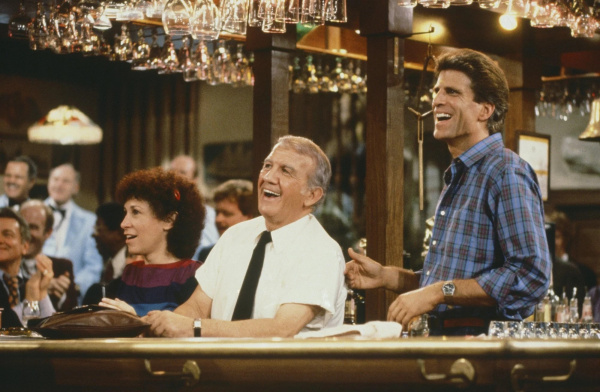
These shows, she writes, “embrace the sitcom’s interest in the absurd, the embodied, and the surreal, as well as comedy’s ability to register confusion, uncertainty, and the contrary emotional states that arise when one must pretend to feel one thing while actually feeling another.”
McClanahan offers an astute close reading of High Maintenance. The protagonist, known simply as “The Guy,” is an affable, low-key young man who bikes all over New York delivering marijuana to customers. McClanahan observes that the show highlights the physical risks involved in this type of work, as well as the connections formed with other types of service workers. In one episode, The Guy’s bike is stolen, and he “must rely on a friend who also works as an Uber driver to ferry him around (for a cut of the tips, of course).”
Many of his customers are also service workers, and he sometimes lingers after his deliveries and socializes with them. “The Guy’s affect doesn’t suggest an indistinction between work and play, but rather a blurring of the character positions of server and served.”
The nuances of “being your own boss”
In a chapter on gig work, McClanahan discusses a recent novel, Luster, by Raven Leilani, in which the protagonist works for the delivery service Postmates. While this labor is low-paid and unglamorous, the narrator describes it in a way that conveys some affection: “I get the first orders of no-pulp orange juice and champagne out of the way. Make pit stops for vanilla Juul pods, small orders of LaCroix and Pampers...occasionally I take the bridge over and field requests by Canal, where I try to protect orders of squid from all that direct sun.”
When she began writing about gig workers, McClanahan was intrigued by the idea of “being your own boss,” she explains. “There’s a version of writing about gig work where you say, OK, that’s just BS. That’s just what the companies want workers to believe.”
On one level, she believes, that’s clearly true. But it’s also more complicated. Chat with your Lyft driver or the person who delivers your Doordash order, and you might hear them extol the freedom to make their own schedules – to work 12 hours on Monday, say, and then spend all of Tuesday at the beach. McClanahan seeks to acknowledge two realities: “that the idea of being your own boss has been deployed in entirely negative and deleterious ways, and that people actually do desire independence.”
Professors as service workers
McClanahan is currently on sabbatical and not teaching at UC Irvine, but she is teaching in a different setting. She serves as faculty co-director for UCI Lifted, a program that offers a B.A. degree to students incarcerated at Richard J. Donovan Correctional Facility in San Diego. The program offers a minor in English, which she coordinates.
She is also deeply engaged with labor issues in her role as co-president of the UC faculty association. In the final section of Beneath the Wage titled, “Ed Tech and the Labor of Teaching,” she explores the ways in which technologies, from online courses to generative AI, have been affecting the university.
Until now, she points out, professors have always operated under the assumption that “you can automate car assembly, but you can’t automate teaching.” Now, with the rise of generative AI, that’s “just not true anymore,” she says. “If we’re not paying attention to that, we will become obsolete just the same way that the hand textile workers became obsolete with the introduction of the power loom.”
To empower faculty, she urges stronger faculty governance and contracts to protect against the use of tech to replace faculty labor. Another solution is for tenure-track faculty unions to work together with other unionized instructors. “We are ourselves,” she writes, “part of the service-working class.” Solidarity with other service workers, she argues, “is not optional.”
In reflecting on her goals for her current workplace, she takes inspiration from a surprising source: the café from which she was fired as a teenager. In 2022, Heine Brothers Coffee – thanks, McClanahan says, to “the amazing organizing of the workers” – became the second largest unionized coffee chain in the country.
Rebecca Tuhus-Dubrow is a writer in residence at UC Irvine's Forum for the Academy and the Public.
Interested in reading more from the School of Humanities? Sign up for our monthly newsletter.