
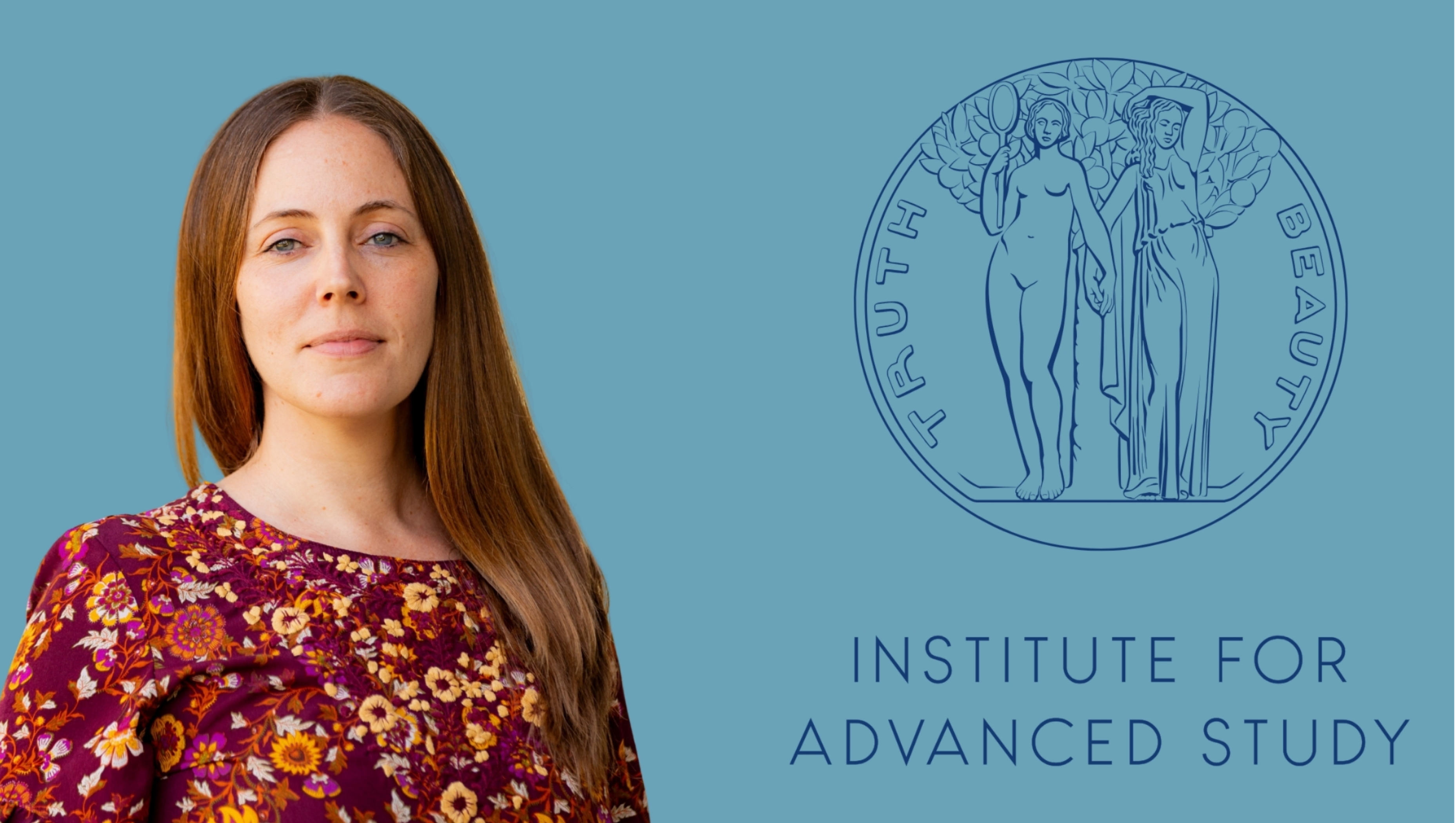
UCI Professor Nicole T. Hughes named member of the Institute for Advanced Study
Nicole T. Hughes, assistant professor of Latin American and Iberian cultures at UC Irvine, has been named a member of the prestigious Institute for Advanced Study in Princeton, New Jersey, for the 2026-27 academic year.
While in residence at the Institute’s School of Historical Studies, Hughes will develop her second book project, Open Endings: Martyrdom and Narrative in the Early Americas. The project stems from Hughes’s research on a surprising facet of Spanish and Portuguese colonialism: most missionaries did not wish to survive in the early Americas. Instead, they sought martyrdom, which locates spiritual redemption in tragic death.
“Spanish and Portuguese colonialism in the Americas is largely a story of death and destruction,” Hughes explains. “What most people do not realize is that Catholic missionaries often did not wish to preserve their lives but rather to die for their faith.” Because Catholicism holds that martyrs intercede on behalf of the living, these missionaries considered martyrdom essential to spreading Christianity overseas. Yet religious superiors were highly skeptical that the Catholic Church would recognize those who perished as “true” martyrs.
Colonizing death
Hughes’s book project traces what happened next. Chroniclers and poets struggled to fit the messy, often chaotic deaths of missionaries in the Americas into the model of ancient Christian martyrdom. They invented new narrative strategies and proposed new historical hypotheses. The debates surrounding these martyrdom campaigns, Hughes argues, helped construct the very idea that the Americas comprised a “New World” distinct from the “Old World” and from Christian antiquity. Disputes over who counted as a martyr also had grave consequences because they factored into arguments used to justify invasions and occupations.
Shaped by the work of her early mentor Serge Gruzinski, a historian who traced how Europeans sought to colonize the historical memory of Indigenous peoples, Hughes became interested in how missionaries tried, and often failed, to “colonize death” by controlling its meaning among the Native peoples they sought to convert.
Drawing on her training in five languages – Spanish, Portuguese, Classical Nahuatl, Tupi Antigo and Latin – Hughes will examine understudied martyrdom accounts written in both European and Indigenous languages. Her early research shows that missionaries tried to impose Catholic conceptions of death in the Americas, including martyrdom, only to have those conceptions constantly challenged – and sometimes even reshaped – by Indigenous beliefs about sacrifice, the afterlife and the social role of the deceased.
Hughes credits her UCI graduate seminar, “Death and Literature in Colonial Latin America,” with giving her project this new direction. “Thanks to conversations with my graduate students, I realized that a lot of scholarship treats death as this universal, biological phenomenon in the early Americas,” she says. “But clearly the different populations there had radically different answers to the questions of where life ends, how embodiment works and what the afterlife entails.”
The seminar resonated with Hughes’ graduate students in the Department of Latin American and Iberian Cultures. “One might assume that a course on colonial literature would have little relevance to our contemporary world,” reflected doctoral student Robert Munrayos. “On the contrary, the one thing we all inevitably share is death.” For Ph.D. student Bernardita García, exploring martyrdom through this lens showed her that “for Europeans, what was at stake was not only the conquest of a new territory or the political role they would play within it, but also the need to morally and spiritually justify their actions, drawing upon what they considered the most valuable possession: the soul.”
Hughes joined UCI after several years at Stanford University, where she was an Andrew W. Mellon Scholar in the Humanities at the Stanford Humanities Center and then served as Assistant Professor of Iberian and Latin American Cultures for five years. Her work focuses on the early modern world, particularly sixteenth-century New Spain (Mexico) and Brazil. Her first book project, Staging History: New Spain, Brazil, and the Theater of the World (under contract with University of Pennsylvania Press) analyzes theater in which missionaries, conquistadors and Indigenous elites staged conflicts set in Europe and the greater Mediterranean and, in the process, created foundational narratives of the conquest and evangelization of New Spain and Brazil.
“As a member of the Institute, I am particularly excited to be a part of the community of scholars in the School of Historical Studies and to attend seminars on early modern history,” shares Hughes. “I am grateful to the dean and associate dean of the SOH and to my department chair for allowing me to take up this once-in-a-career opportunity.”
Interested in reading more from the School of Humanities? Sign up for our monthly newsletter to read more.