
Celebrating the life and legacy of Ngũgĩ wa Thiong’o
The School of Humanities honored the life and work of renowned author and UC Irvine Distinguished Professor of Comparative Literature and English Ngũgĩ wa Thiong’o in a celebration that brought together international scholars, colleagues, students and community members.
Associate Professor and Chair of Comparative Literature Adriana Michele Campos Johnson reflects on the event and the student artwork inspired by his legacy:
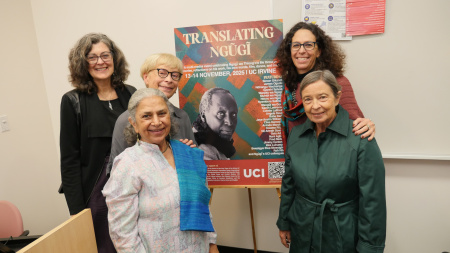
"Translating Ngũgĩ: From Here to There/From Then to Now” was a multi-modal celebration of Ngũgĩ wa Thiong’o's life and work held at UCI on November 13-14, 2025. That the organizing committee counted with faculty from several schools reflected Ngũgĩ’s importance across the entire campus: myself, Jane O. Newman (Comparative Literature), Gabriele Schwab (Comparative Literature) and Jerry Lee (English, ICWT) from the School of Humanities; Ketu Katrak (Drama) and S. Ama Wray (Dance) from the School of the Arts and Cecelia Lynch (Political Science) in the School of Social Sciences. Co-sponsors and support for the event also poured in from across the campus.
For two vibrant days we reckoned with the tremendous scope of Ngũgĩ’s legacy as a thinker, writer and person. International scholars such as Gayatri Chakravorty Spivak, Wangui wa Goro, Simon Gikandi, James Ogude, Cilas Kemedjio and Akosua Adomako Ampofo spoke to his enduring impact on generations of African writers and scholars, and the continued resonance of his arguments on language politics and the need to decolonize habits of mind. We also heard from colleagues who worked alongside Ngũgĩ when he served as the founding Director of the International Center for Writing and Translation at UCI, revisiting the excitement of his founding vision for a center guided by the principle that translation is the language of languages and that cultural contact is the oxygen of civilization.

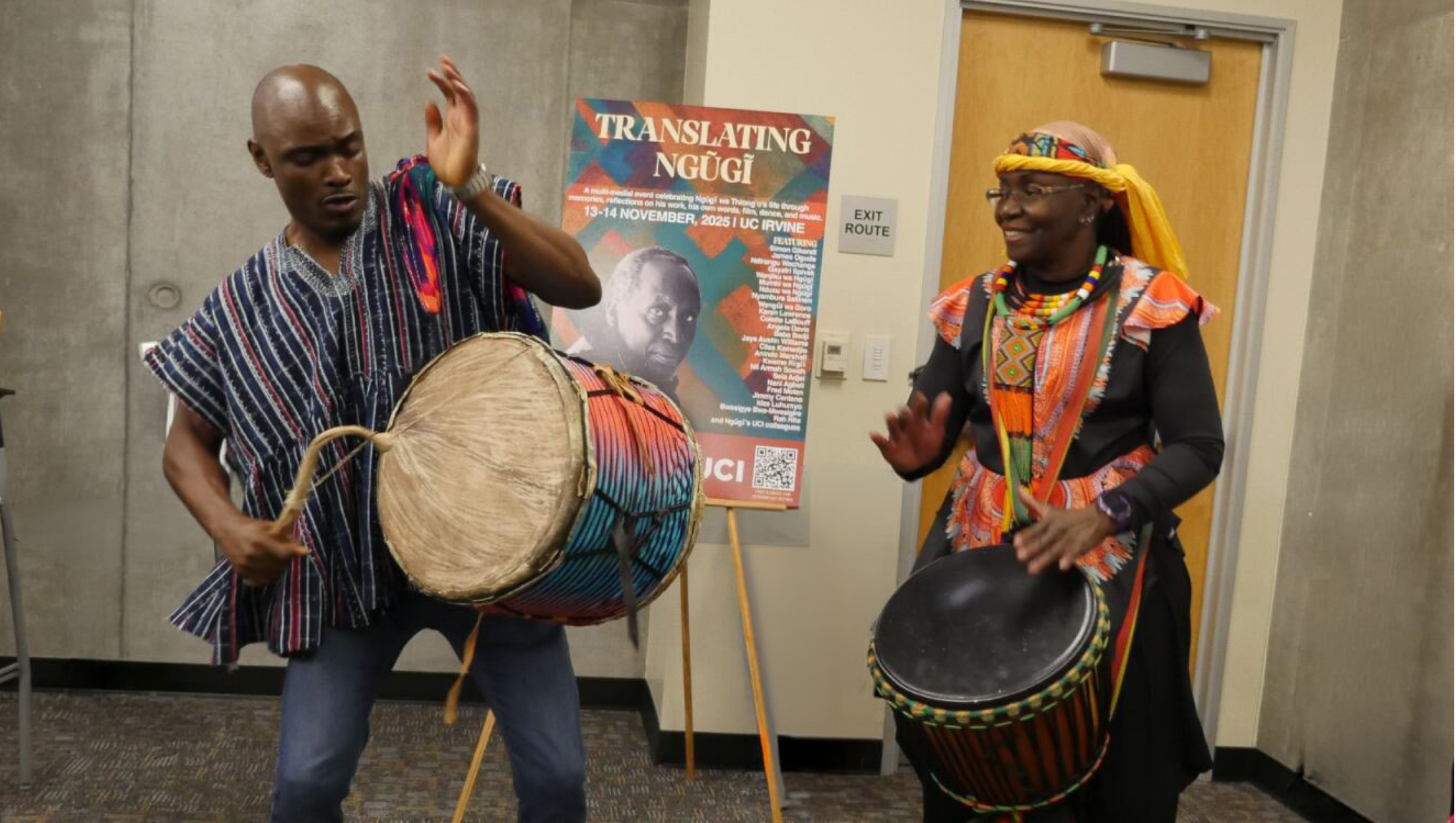
On one panel Ngũgĩ’s short stories “The Upright Revolution” and “The Perfect Nine” were read in a variety of African and other languages. We screened an excerpt of Ndirangu Wachanga’s documentary about Ngũgĩ as well as a documentary made in 2014 about the production of Ngũgĩ’s play, The Trial of Dedan Kimathi at UCI. We also heard stories from his children and grandchildren. The proceedings were punctuated throughout by the drumming of Anindo Marshall and Nani Victor Agbeli and ended with the exhilarating multimedia performance Harambee directed by S. Ama Wray and a healing dance workshop led by Nii Armah Sowah. All bore witness to Ngũgĩ’s humor, clarity of mind, generosity and love of dancing. (To view photos from the event, scroll to the bottom of the article.)
Finally, the organizing committee partnered with the libraries to stage an exhibit of student responses to Ngũgĩ’s work in the Science Library this quarter. Our wish and hope was that Ngũgĩ’s legacy be remembered widely and deeply across the campus and that his work, even this year, may find its way to new readers and new students not only studying African history or literature but also interested more broadly in questions of decolonization, the politics of language across the globe, the power of theater and resistance to authoritarian states.

-
Awakening by Adalynn Roos, Global Cultures student

“Being is one thing; becoming aware of it is a point of arrival by an awakened consciousness and this involves a journey.”
— Ngũgĩ wa Thiong’o, In the Name of the Mother: Reflections on Writers and Empire
Petals of Blood was one of the first books by Ngũgĩ wa Thiong’o that I read, and it changed the way I understood both humanitarian work and Africa itself.
In this piece, the orchid (Kenya’s unofficial national flower) grows from the book as a symbol of cultural knowledge and conscious awakening. Entwined with it is yellow cestrum, depicted as a weed that competes with and presses against the orchid. The cestrum represents imposed narratives. Becoming aware of the world and its systems, whether good or bad, is neither clean nor fast. It involves friction, resistance and the constant negotiation of what is allowed to grow. Through listening and learning, however, growth and understanding can emerge.
- Hurricane by Fer de la Cruz, Spanish Ph.D. student
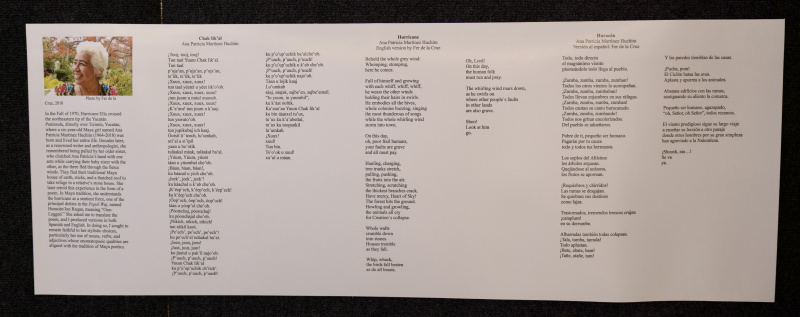
Ngũgĩ wa Thiong’o’s work insists on the political and ethical importance of writing, translating and imagining from within Indigenous and subalternized worlds. Ngũgĩ understood language as a site of struggle and as a living medium through which cultures breathe, remember and endure: A way of allowing stories to travel without erasing the worlds from which they emerge.
The poem "Huracán / Ciclón" by Maya writer and anthropologist Ana Patricia Martinez Huchim (1964-2018) speaks from a parallel terrain. Written from within what can be understood as an internal colonial condition in Mexico, the poem recalls the experience of Hurricane Ella as lived by the poet herself as a six-year-old Maya girl in Tizimín, Yucatán. In Maya cosmoperception, the hurricane is not a metaphor but a sentient force: Huracán or Jun Raqan, “One-Legged,” a primordial deity also present in the Popol Wuj. The poem preserves this worldview through sound, rhythm and onomatopoeia, activating a poetics in which nature, memory and agency are inseparable.
My English and Spanish translations of this poem seek to honor that poetics without domesticating it. Following Ngũgĩ’s understanding of translation as a decolonial practice, these versions aim not to overwrite the original voice, but to let the Mayan memory and imagination resonate across languages. Placed side by side, the three versions invite readers to experience translation as a movement, relation and shared breath.
-
Aftermath of a Crisis by Meredith Lo, Computer Science student

Using a quote from Ngũgĩ in an interview regarding the 2007-2008 Kenyan crisis, I created a piece of blackout poetry highlighting how the divisiveness in Kenya during this politically tumultuous time was leading them towards catastrophe. In 2010, a new constitution was approved thanks to the people joining together in an effort to prevent a reoccurrence of the violence. This poem is an examination of what may have happened in the aftermath of the crisis if unity had not been achieved.
Beyond the poem, I also wanted to incorporate other aspects of this history: the background of overlapping blue and orange streaks represents the clash between the two parties, Kibaki’s Party of National Unity and Odinga’s Orange Democratic Movement. The flames warping nearby elements show how ethnic and political violence stemming from the election results would spread wildly in the form of fires, whether they were literal fires, firearms or the firing of tear gas.
The student pieces will be featured at the Science Library through March 2026. To learn more about Ngũgĩ wa Thiong’o’s life and impact, read Professor Gabriele Schwab’s personal essay or watch and read touching tributes at the event website.
Interested in reading more from the School of Humanities? Sign up for our monthly newsletter.