
Ghosts in the classroom
By Nikki Babri
When Delilah Miranda Rodriguez signed up for the course “Ghosts and Fantasies,” she was expecting to learn about popular urban legends like Japan’s “Slit-Mouthed Woman” and “Hanako of the Toilet.” Instead, she was met with a story about a woman whose heartbreak was so strong it split her soul from her body.

“My ideas of ghost stories were completely off,” says Rodriguez, a second-year criminology, law and society major who had previously equated ghosts with evil spirits. “Each tale contains bits and pieces of history, even when it’s not the most apparent.”
This shift in perspective is exactly what the course, taught by Xiao Rao, assistant professor of East Asian studies, aims for. The class spans the first millennium BCE through the 19th century, introducing students to the ghosts, monsters and fantastic creatures of East Asia, and what those stories reveal about the people who told them.
Haunted by memory
“I’ve long been fascinated by ghost narratives because they seem to capture something fundamental about memory: the anxiety of being forgotten, and the struggle of people and experiences to linger even after they are supposed to have disappeared,” Rao shares.
His research examines how narratives of the strange and anomalous, such as ghost stories, preserve personal and collective memories of war, displacement and social upheaval. “Although these people may have disappeared from the historical record, their experiences continue to haunt the stories told by survivors,” he says.
That research shaped the course, which treats ghost stories as a record of how ordinary people remembered the past and made sense of their world. Xiangu Qi, a Ph.D. student in East Asian studies and the course’s teaching assistant, states it simply: “Ghost stories are not merely about ghosts.”
They are, paradoxically, about the living. “At their core, ghost stories are human narratives told from an alternative perspective,” Qi explains. “They explore how people, within specific sociocultural contexts, make sense of the world and engage with the unknown – realms that lie beyond the reach of existing language and established systems of knowledge.”
The merging of souls
While Western traditions generally imagine a single soul, early Chinese belief held that each person had two: the hun, a light, airy soul that leaves the body at death, and the po, which remains with the corpse. As a result, the difference between a ghost and the living could be hazy. Even a first-century Chinese dictionary defines gui, or ghost, as “the occasion of a person making a return.”
That idea is clearly reflected in Chen Xuanyou’s 8th-century tale, “An Account of the Detached Soul.” In the story, a young woman named Qianniang is in love with her childhood sweetheart, Wang Zhou, but her father arranges a different match. Heartbroken, Wang leaves town by boat but is surprised when Qianniang appears at the dock to run away with him. Five years and two children later, the couple returns home to make amends, only to learn that Qianniang had been bedridden in her father’s house since Wang left. The woman who eloped was her soul, and the two halves merge back into one.
“I was not expecting that,” Rodriguez admits. “It was such a unique concept to have Qianniang’s heartbreak be so strong that it separated her soul from her body. It makes me wonder if those children were half ghost and half human.”
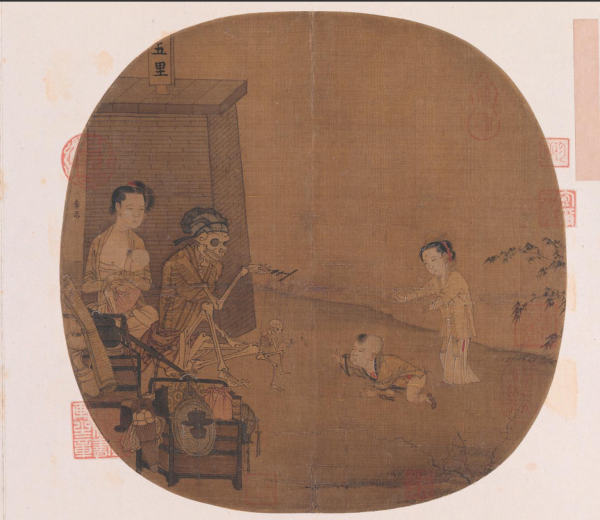
Li Song 李嵩 (act. 1190–1230), “The Skeleton Puppet Master” (Kulou huanxi tu 骷髏幻戲圖), Fan painting, ink and color on silk, Southern Song dynasty. Photo credit: Palace Museum Beijing.
The familiar vs. the unknown
Students quickly learn that these stories have more in common with the Western tales they’re familiar with than they might expect. “One thing I hope students discover is that there is no single kind of East Asian ghost, just as there is no single kind of Western ghost,” Rao says.
Just as Hades rules the realm of the dead in ancient Greek mythology, Chinese stories feature King Yama, who presides over the underworld. “The details differ,” Rao observes, “but both traditions imagine the afterlife as a world that somewhat mirrors the order and authority of humans.”
Across cultures, many of the same themes and jokes recur. One medieval Chinese story follows a traveler named Yuan Wuyou who spends the night at an old mansion and encounters four seemingly refined gentlemen who write him poems. The next morning, Yuan finds himself in a deserted house and realizes the poems had been riddles revealing the men as the spirits of ordinary household objects. The final twist is the traveler’s own name, which literally means “Originally Not-Existing” and was a clue all along.

Readers of Homer’s Odyssey will recognize the trick from Odysseus, who escapes the Cyclops by calling himself “Outis,” or “nobody” in Greek. “In both stories, the joke is played not only on the characters but also on us as readers,” Rao says.
Qi notes that the differences can be just as revealing. While Western readers often expect ghosts to be either good or evil, “ghosts in East Asia cannot be neatly categorized into a binary,” she says. Many return to right a wrong, and the injustices they address are firmly rooted in reality. “These stories often contain critiques of certain social issues that are frequently overlooked by official narratives,” Qi explains.
An archive of the strange
For many students, the biggest surprise in the course is simply how many of these stories exist. Hong Mai’s 12th-century Record of the Listener (Yijian zhi) originally held around 4,000 tales. Although much of it has been lost, roughly 2,700 stories survive – a number Rao has not found matched by any single premodern collection of its kind elsewhere.
The tales also range well beyond “typical” ghost stories, instead including strange animals, dreams and other kinds of uncanny encounters. “This corpus is more like an archive of what people in the past found strange, troubling, fascinating or difficult to explain,” Rao says.
Some of the most popular narratives feature spirits passing as humans. In “The Story of Ms. Ren,” a poor young man falls in love with a beautiful woman who turns out to be a fox spirit in disguise. He stays with her, and she proves more loyal than the humans around her. In “The White Snake,” one of China’s best-known legends, a snake takes human form and marries a kind young man, only for a meddling monk to expose her true nature.
Rather than fading with age, stories like “The White Snake” persist, evolving as new generations make them their own. “These stories are constantly reshaped to resonate with audiences across diverse social contexts,” Qi says. In earlier versions of the tale, for example, the Green Snake serves solely as a companion and witness to the romance between the White Snake and her human lover. Recent animated adaptations, however, have given the friendship between the Green and White Snakes far more attention.
“This shift is inseparable from the growing recognition of, and consensus around, feminism within contemporary Chinese society and culture,” Qi states.
The need to remember
Why read premodern ghost stories now? Beneath their fantastic surfaces, Rao notes, these narratives reflect questions that we still ask today: How do we remember the recent past? And how does a society or community decide what counts as normal, what seems strange and what its people consider possible?
He believes those questions feel especially pressing for students who grew up through a global pandemic and now live in an information environment shaped by short videos, social media, algorithms and AI.
“We constantly produce and circulate information, but that does not necessarily mean that we remember better. In some ways, it may make forgetting easier,” Rao says. “I hope this group of literature will provide students with new ways to think about history, society, religion, memory and the boundaries of human knowledge.”
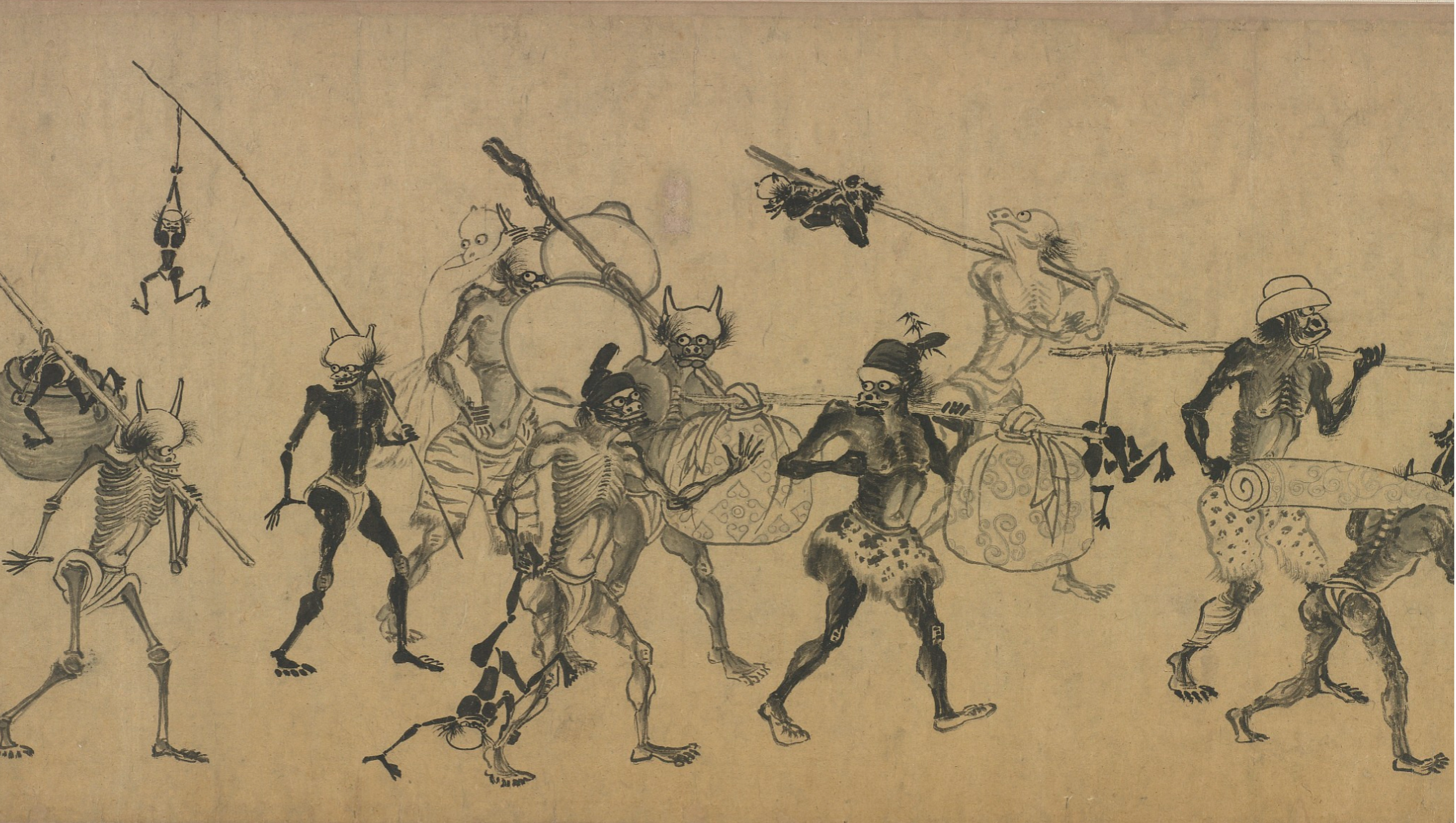
(Main image: Gong Kai 龚開 (1222-ca.1307), Zhong Kui Travelling 中山出遊圖卷. Handscroll, ink on paper. Photo credit: Freer Gallery of Art, Washington D.C.)
Interested in reading more from the School of Humanities? Sign up for our monthly newsletter.