
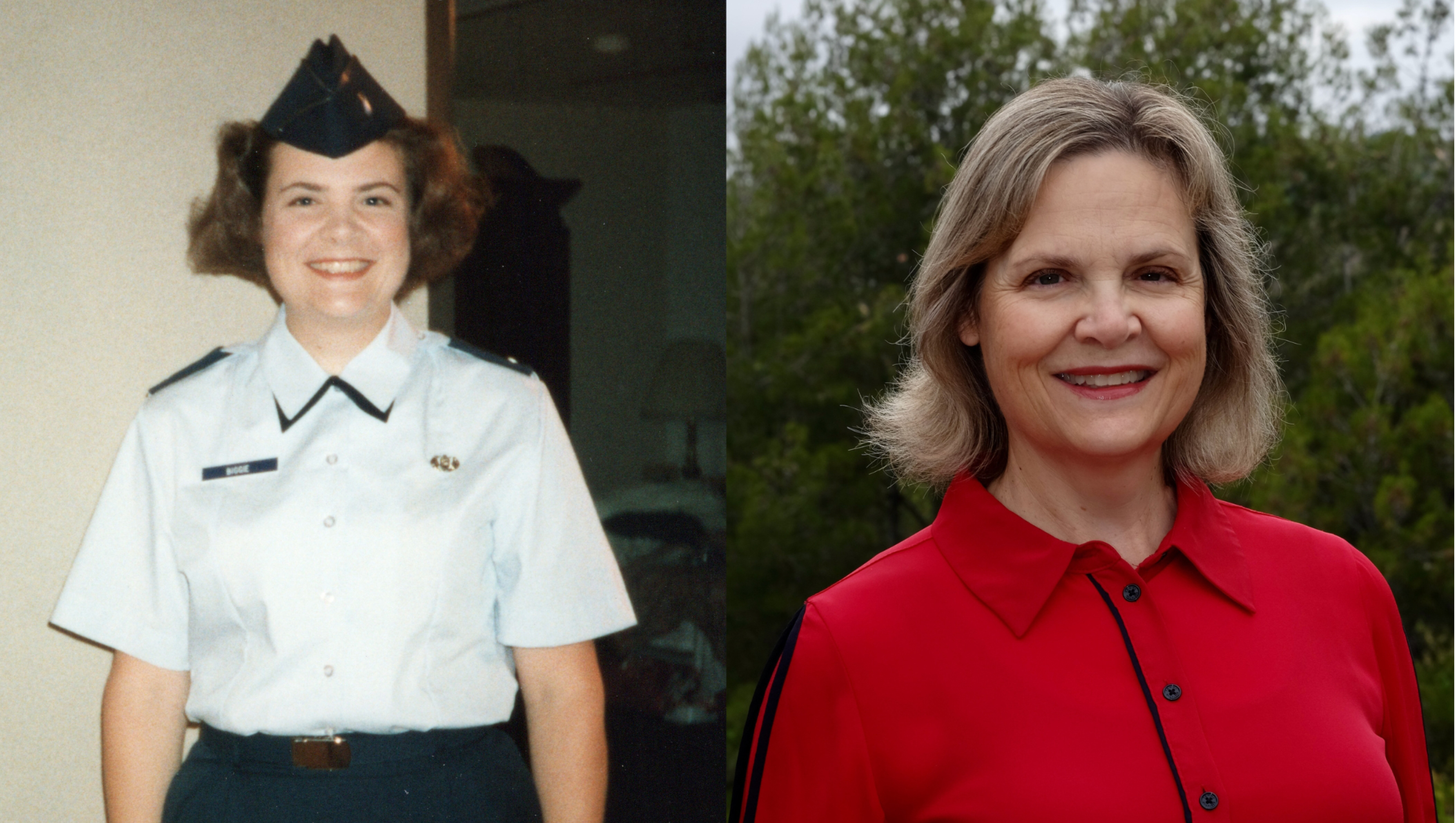
Col. Natalie D. Richardson: 30 years of public service
By Nikki Babri
In her senior year of high school, Natalie Richardson ’92 (B.A. German) and two classmates applied for a summer program in Germany. Their teacher could nominate two students and, while one was the clear choice, the teacher was unable to decide between Richardson and the other student. In the end, the teacher nominated neither, and the second spot went unused.
“That injustice really bothered me,” Richardson says. “First, there’s a spot going untaken. And second, it’s your job to make a decision. I guess that’s the judge in me, which I later became.”
She eventually made it to Germany, and went on to serve 30 years in the U.S. Air Force, retiring as a judge on its Court of Criminal Appeals. This November, just days before Veterans Day, Col. Richardson was honored with the 2026 Lauds & Laurels Distinguished Alumni Award for the School of Humanities.
“My humanities studies helped build a foundation for my career – a full and adventurous career in law and in the military,” she says. “I am truly humbled and honored to be recognized for my service, which also happened to be doing what I loved.”
Getting to Germany
Though Spanish would have made more sense for someone who grew up in Orange County, Richardson chose to study German in high school. She felt a connection through her father’s side of the family, who had emigrated to the U.S. in the mid-1800s.
As a first-generation student, she navigated the college process largely on her own. To avoid debt, she lived at home, worked, and commuted to UCI, arriving undeclared in the School of Humanities. A career exploration course suggested she become a military officer. “And I said no,” she recalls with amusement.
Determined to get to Germany through college instead, Richardson applied to the Education Abroad Program, which required her to choose a major. She declared German, later adding a minor in anthropology and, in fall 1990, she arrived in Göttingen. She turned 20 there, experienced her first true fall and winter and spent every school break exploring, sleeping in youth hostels and train stations across 13 countries.
“It was one of the best years of my life, and an experience everybody should have,” she says. “It would do a lot of people a lot of good to get out of their comfort zone, go somewhere else, experience what other people in the world experience – how other people see the world, and how they see us.”
Learning the law
After graduating, Richardson enrolled at California Western School of Law in San Diego, planning to practice family law. She found that her German degree, with a linguistics emphasis, had prepared her well.
“They’re going to teach you the subject matter, you don’t need to go in knowing constitutional law,” she explains. “But you need to be able to critically think, analyze, write and communicate. I had practice learning something foreign, analyzing it and breaking it down. I think my writing is certainly better for having studied German.”
In her final semester, a friend mentioned they were looking into the Army’s Judge Advocate General’s (JAG) Corps. For Richardson, who had loved her year abroad, the appeal was immediate. Her father and several uncles had served in the Air Force, so she applied there, ruling out the Navy partly because, in her 24-year-old brain, she didn’t like the all-white uniforms. “I didn’t wear white pants,” she laughs, adding, “I do now, but that’s beside the point.”

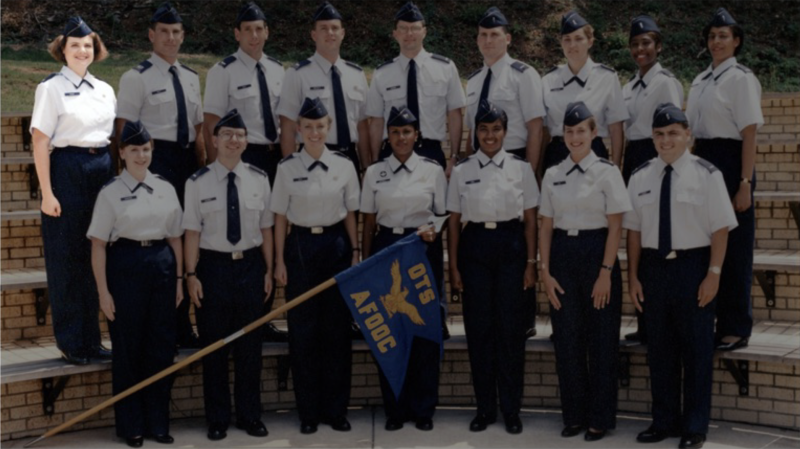
Once she was accepted, things moved quickly: she graduated in December 1994, took the California bar exam in February, was sworn in in June. By July 1995 she was driving to Alabama for Officer Training School and planned to serve the minimum four years and get out with good experience. “The military is great for giving young attorneys experience, and for learning what you enjoy and want to do,” she explains.
At her first base, she prosecuted cases as well as rotated through legal assistance and military justice in three years. “They just kept giving me what I wanted next,” she says of why she stayed. “And it turns out I like having a new job every few years. I like moving and exploring and learning new places.”
Service at home and abroad
Richardson came up at a time when Air Force leaders were making a deliberate effort to recruit more women into the ranks. Her Officer Training School class had as many women as men, if not more. “That was on purpose,” she says. “Kudos to the leadership around that time.”
Over the first half of her career, she worked across nearly every corner of military law as a prosecutor, defense counsel, mentor and policy expert before leading a base legal office and advising the base’s top commanders. Along the way, she also earned a master’s degree in military operational art and science.
In 2009, her service became international. She was deployed to the United Arab Emirates for five months as a lieutenant colonel, serving as the base’s only lawyer alongside a single paralegal. Her children were still toddlers, but her husband, whom she met in law school, didn’t hesitate.
“He said, if this is going to be good for your career, go off and do it,” she remembers. He cared for their children, who turned two and four while she was away. Before she left, she recorded good-night messages into Build-A-Bears, and often video-called home in time for breakfast so the kids could see her on the screen while they ate. Her daughter still has the bear.
In 2011, Richardson became a trial judge in Nebraska, presiding over more than 105 courts-martial before leading a circuit of trial judges across the western United States. As vice commander and later commander of the Air Force Legal Operations Agency, she oversaw more than 900 legal professionals at 76 locations worldwide and steered them through the early months of COVID-19.
Across her career, she received the American Bar Association’s Outstanding Military Service Career Judge Advocate Award, as well as three Legion of Merit awards – one of the Armed Forces’ highest decorations.
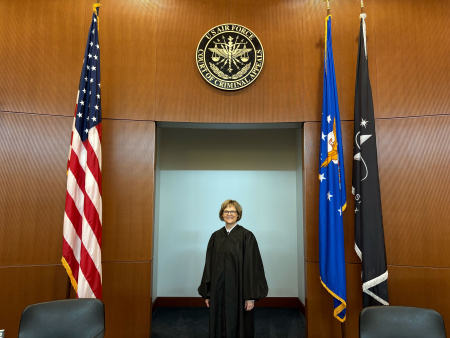
Her final role brought her back to the skills she first sharpened as a German major. She served as an appellate judge on the Air Force Court of Criminal Appeals and as deputy chief judge of the Court of Military Commission Review, the appellate court for the Guantanamo trials. “On the Air Force court, we actually write the opinions. So I’m at my keyboard, typing it all out,” she says. “It’s not just being able to spot good writing; I have to do the writing. And I loved it. I love writing.”
Finding success in what you enjoy
Over three decades, the Air Force took her to Alabama, Florida, Nevada, D.C., Illinois, Ohio, the UAE, Nebraska, California and Maryland. When she reached mandatory retirement after 30 years, she admits she would have gladly stayed. “I loved the work. It wasn’t work,” she says. “The best job is when it doesn’t feel like work.”
Now back in California near family in San Diego, with both of her children living in Europe, Richardson has stayed connected to UCI through Alumni Association events across the country.
“Col. Richardson embodies the qualities we value most in Humanities alumni – discipline, intellectual curiosity, ethical leadership and a sustained commitment to public service,” shares Nasrin Rahimieh, associate dean of the School of Humanities.
For students on less conventional paths, Richardson’s advice is to give their best to what’s in front of them. “Keep your eye on what’s ahead of you, but don’t lose focus on what’s in front of you to jump ahead,” she says. “It’s okay that you’re in a niche or unconventional area, because you enjoy it, you’re good at it and you’re succeeding in it. That success is what’s going to lead to the next step of what you want. It’s not necessarily the subject; it’s the success.”
Interested in reading more from the School of Humanities? Sign up for our monthly newsletter.