
Today’s young adults live in what the former U.S. surgeon general has called an “epidemic of loneliness and isolation.” Moreover, a recent study by the Harvard Graduate School of Education showed that nearly two-thirds of college-aged youth say they lack purpose; half of them describe the anguish of “not knowing what to do” with their lives.
The academy should have an answer to this malaise. But has our emphasis on scholarly independence caused us to ignore our responsibility to elevate moral purpose? As Dallin H. Oaks, former president of Brigham Young University, told a gathering of Harvard students, “The academy can pretend to neutrality on questions of right and wrong, but society cannot survive on such neutrality.” An academic ethos that values truth-seeking but excludes character development has left many students and communities wanting.
Less than half of Americans (only 42 percent) express confidence in American higher education, according to an education survey by the Lumina Foundation and Gallup. This crisis of confidence is particularly pronounced among conservative and religious Americans. Many share the concern that Rabbi Ari Berman, president of Yeshiva University, articulated at an American Council on Education meeting: “Today’s universities have elevated academic freedom above moral clarity.” Have we pushed the academic enterprise toward what Harry R. Lewis, former dean of Harvard College, once called “excellence without a soul”?
Faith-based colleges and universities (FBCUs) have tried to withstand this disconnect. Their mission statements are decidedly oriented toward teaching character. Some critics see this as a relic of the past, especially at a time when the number of people who disavow any religious identity continues to grow. The Pew Research Center has repeatedly documented this pronounced rise in religious disaffiliation among college-age Americans.
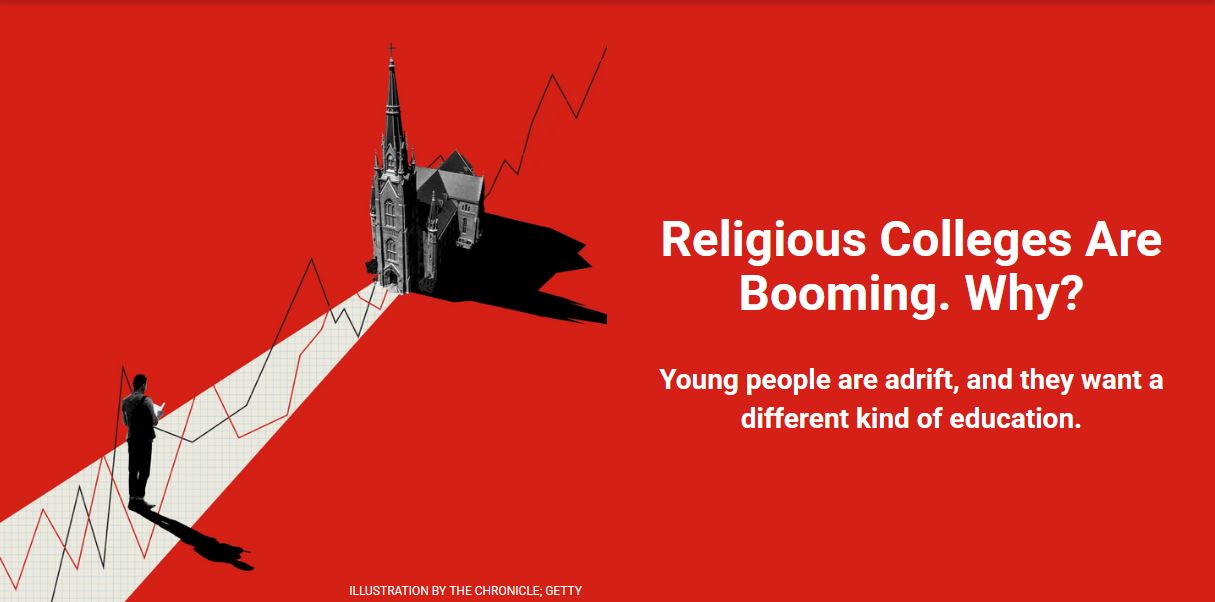
And yet, despite this trend, enrollment at faith-based colleges has been quietly growing for decades. According to the National Center for Education Statistics, total enrollment at faith-based institutions has risen by more than 80 percent since 1980, significantly outpacing the national average. Today there are over 1.8 million college students enrolled at over 850 FBCUs. In a recent meeting of the American Council on Education’s Commission on Faith-based Colleges and Universities, presidents from Baptist, Catholic, and Jewish colleges reported sustained increases in student applications. This has also been true for the Brigham Young University system, where enrollments have doubled in the last 25 years, growing from 75,000 students in 2000 to over 150,000 students today.
Part of the reason FBCUs are flourishing is that they promote discussion of purpose and meaning in a season of growing social uncertainty. They also provide safe spaces for religious students to connect to their most deeply held beliefs. As Eboo Patel, founder of Interfaith America, explains, “People with a particular religious identity … need a place where they can have their identity supported, especially when that religion has a history of facing bigotry, as the Latter-day Saints, Jews, and Catholics certainly have.” Patel goes on to argue that like the nation’s historically Black colleges, FBCUs provide a welcoming refuge for members of religiously marginalized groups.
Beyond offering a spiritual refuge, the missions of FBCUs establish a shared framework that encourages discussion of character. Students typically commit to a code of conduct, engage in faith-based curriculum, and interact with faculty mentors who have been charged to develop their students’ moral and spiritual lives. This clarity is particularly attractive to students and families looking for more than a transactional degree.
Remarkably, the enrollment growth at faith-based institutions isn’t all from religious students. It appears that even nonreligious students want to learn in a community oriented toward elevating character. For example, Yeshiva University, a historically Jewish enclave, reports than its recent enrollment growth includes many students who aren’t Jewish or even religious. They simply want to study in an environment that respects faith and isn’t hostile to discussions of meaning and purpose.
Efforts to support character development in secular colleges can still include efforts to promote student access to religious communities. Forward-thinking institutions are supporting independent programs such as Hillel for Jewish students, Institutes of Religion for members of the Church of Jesus Christ of Latter-day Saints, Newman Centers for Catholic students, and the InterVarsity Fellowship for Protestants. Universities like Arizona State University and the University of Utah additionally signal such support when they provide “clean-living” dorms, where students commit to abstaining from alcohol and substance use regardless of religious affiliation.
Beyond preserving space for religious student communities, how can secular colleges teach “character,” given the huge range of competing values and beliefs on their campuses? James Davison Hunter, a sociologist who developed the concept of “culture war,” contends in The Death of Character: Moral Education in an Age Without Good or Evil (2000) that a moral culture not grounded in religious belief lacks the permanence that comes with spiritual grounding. The risk is that without a shared mooring, morality gets reduced to nonbinding platitudes and “virtue on the cheap.” Still, the very fabric of strong democratic culture depends on strong democratic character. An anchoring in substantive values can be achieved, even in settings with diverse stakeholders, if leaders will engage in deliberate pluralistic bridge building. As the New York Times columnist David Brooks reminds us in The Road to Character (2015), collective efforts at character development must transcend political or religious affiliation while still preserving space for shared beliefs and values. In many ways, this is the essence of the American enterprise. The key to avoiding Hunter’s pitfalls may be to approach character education in a way that preserves religious and cultural differences but also finds common moral ground.
While character education is not new, the polarized context in which colleges now operate may be. A growing number of nonreligious colleges are striving to motivate character initiatives that are based on distinctive academic purpose, historical mission, and even community stewardship. These include longstanding efforts at U.S. military academies, a series of character-focused programs being developed in Britain, more traditional U.S. programs grounded in the humanities, and an emerging group of civics programs focused on the American democratic context.
Let me start with the U.S. military academies. The Air Force Academy operates on three core character principles: “integrity first, service before self, and excellence in all we do.” The Naval Academy focuses on “honor, courage, and commitment.” These declarations of character are not confined to aspirational mission statements but are embedded in the curriculum. For example, the Air Force Academy has formal first-year and third-year seminars that reinforce the institution’s core values with lectures, readings, and biographical profiles. They further embed specific lessons in more traditional academic coursework through exercises that reinforce their values in real-world settings. The military academies also model longstanding efforts to provide ministerial support for their students. Of course, the establishment clause precludes endorsement of any one specific religion, but it does not block the provision of religious support from nondenominational chaplains. The military’s chaplaincy program has been incorporated into the academies to support the faith and spiritual needs of students without compulsory engagement or reliance on any one specific religion.
In the United Kingdom, efforts like the Oxford Character Project and the Jubilee Centre for Character and Virtues help articulate “holistic character development” in ways that incorporate faith but are not inherently religious. For example, the Jubilee Centre develops curricula linked to civic, intellectual, and moral virtues. They also conduct research on the link between these virtues and human flourishing (health, marriage, civic engagement, happiness, and other social outcomes). Through the rigor of this scholarship, they encourage both secular and religious universities to focus on moral content in ways that honor the moral agency of students — including when rooted in religious creed and doctrine. Programs include readings from literature, philosophy, and religious texts. Whereas many American approaches either completely exclude religious framing or have a decidedly denominational focus, these British efforts include faith without becoming specifically religious.
Many American colleges are also elevating discussions of character. Wake Forest University has developed the Educating Character Initiative, a national network of colleges committed to putting character at the center of curriculum. Much of this work is designed to provide training, benchmarks, and structural support for institutions developing character-focused programs. Examples of these resources include workshops to define program outcomes and establish evaluative measures, including perception and impact surveys as well as instruments to assess content mastery and recall.
Many advocates for character instruction point to liberal-arts education in the humanities as a source of shared values on which character education can be developed. What do we learn about truth and reason from Socrates, Descartes, and Locke? What can we learn about character from Dante’s The Inferno, Dostoevsky’s The Brothers Karamazov, or T.S. Eliot’s Murder in the Cathedral? Other programs use literary sources to engage core institutional academic principles. The Anteater Virtues Project at the University of California at Irvine is a cross-disciplinary humanities program that focuses on anchoring values of curiosity, integrity, and intellectual humility.
Other efforts to teach character include a growing number of civic-education programs. These efforts include new academic programs and degrees rooted in civic virtue, such as Arizona State University’s B.A. in civic and economic thought and leadership and Princeton University’s James Madison Program in American Ideals and Institutions. These programs are not identical in moral content or moral pedagogy, but they share a commitment to character development that targets civic engagement in ways that go beyond platitudes. We should applaud these and other efforts to find pluralistic approaches to character formation in both curricula and scholarship.
Truth-seeking that excludes character development will not help a generation that already feels lost. With two-thirds of college-age youth reporting that their lack of purpose is affecting their mental health, the calls for character education aren’t just moralistic charges from a few religious colleges. The nation needs higher education to do more. And the continued rise in enrollment at religious colleges is a sign that students want more. Universities like Arizona State, Princeton, Wake Forest, and others are striving to teach character despite not having a shared national service or religious mission. Regardless of institutional heritage, these efforts require humility and a willingness to search for common ground, including efforts to accommodate religious identity and other deeply held values. But that is exactly what our nation’s young adults need as they face this on-going crisis of meaning and purpose.
We welcome your thoughts and questions about this article. Please email the editors or submit a letter for publication.