Abolition Medicine and Bilingual Narrative Arts
Abolition Medicine and Bilingual Narrative Arts
—A Symposium on Care, Community Health, Code-Switching & Creativity—
Friday, May 29th & Saturday, May 30th, 2026
UC Irvine, Room: HIB 135
This event brings together scholars, artists, writers, and health practitioners to reimagine ways to create spoken, written and visual health narratives in community, thinking with and beyond modern medicine to reimagine health as a collective, transdisciplinary question.
We gather to reimagine alternative ways of taking responsibility for the collective health of the living, and to share stories that are personal and political, across disciplines, professions and cultures. We gather to learn, to listen, to reimagine our own professional practice, and to offer one another practical tips and guidance to facilitate further gatherings where these conversations and knowledge can be passed on to others in community spaces.
The health of marginalized groups can be negatively impacted by structures that we are responsible for changing and demand constant reexamination. Many institutions are led by people who mean well and yet might unwittingly reproduce a heritage of antiblack colonialist patriarchy that can still be operating in institutional habits and procedures, and ways of “wording the world” (Mika) including the university and modern medicine. We can think together with the tools of science and the arts, open to “hospicing modernity” (Machado de Oliveira), while reimagining and practicing collective care and abolitionist place-making (Gilmore) (McMullin).
This symposium offers and welcomes critical perspectives on illness narratives, social medicine, deep medicine (Marya & Patel) and abolition medicine (Iwai, Khan and DasGupta) that play with the spectrum of bilingualism and/or code-switching to think about the interpersonal construction of narrative medicine (Charon) in contexts of sociolinguistic and cultural (in)competence, (mis)translation, or generative illegibility (Lee et al.). We want to expand the notion and practice of community health with transcultural (Magaña) and transformative intentionality.
We invite speakers to think about ways of using the tools of writing, spoken word, visual storytelling and/or ceremony, while holding space for each other’s stories and thoughts. We’ll offer workshops where to think and play with words—in English, Spanglish or other bilingual/code-switching—as well as through non-verbal/rhythmic ways of connecting such as drawing, coloring, music, and being.
Contact: Rocío Pichon-Rivière pichonrm@uci.edu
Event co-sponsored by UCHRI, the Department of Latin American and Iberian Cultures , UCI Illuminations, the UCI Graphic Narratives Research Cluster and the Center for Medical Humanities.
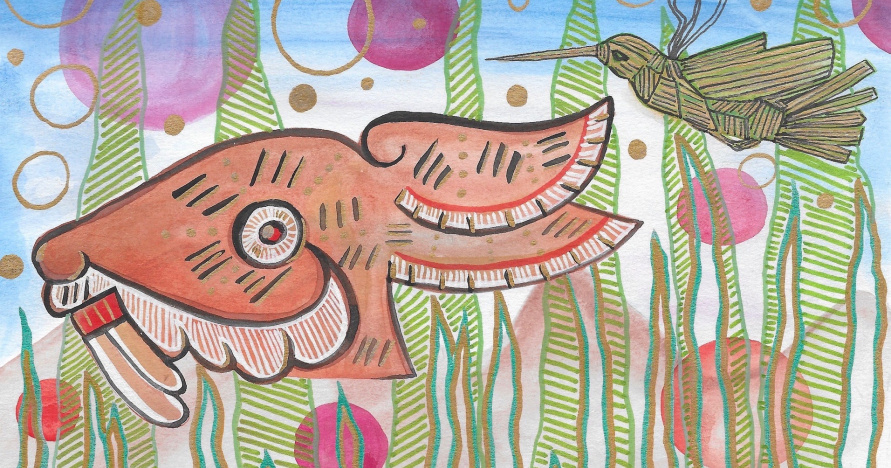
Image credit: Cynthia Huerta.