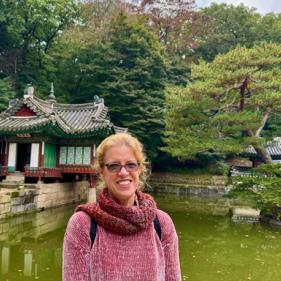
I’m a professor of English literature, but I’m writing this now from the campus of Yonsei University in Seoul. A few years ago, I could never have dreamed I would end up here, given my interest in the influence of the philosophy of mathematics on Victorian literature. During the COVID lockdown I had begun studying the Korean language as a hobby, fascinated by its distinctive affordances for poetry. But Professor Jeon and the CCKS encouraged me to think further about what had begun as a peripheral interest, introducing me to people working in Korean studies both at UCI and in Seoul. From a website curated by Professor Hyungji Park of Yonsei University I first learned about Percival Lowell’s Land of the Morning Calm--an account of his 3-month sojourn in Korea during 1883-4—and Professor Park’s examination of imperialist narratives in the Korean context and in relation to visual media led me to think about the implications of the fact that this book was illustrated with photographs. Since the publication of Edward Saïd’s Orientalism, the notion that the Western conception of “the Orient” serves a program of Western self-idealization has been a commonplace: for Saïd, the Oriental “Other” is defined by the West as lesser even as it serves as its mirror image. But Percival Lowell’s writings on Asia are shaped by a very particular kind of mirror metaphor, one that’s specific to the American perception of East Asian culture in the late nineteenth century: what the Victorians called the “magic mirror” of photography.
The special qualities of this mirror are on full display in Lowell’s book. During the nineteenth century, photography was bound up with new accounts of knowledge and the physical world, and Lowell belongs to the lineage of art photographers who understood the “realism” of photography to be grounded, not in its fidelity to detail, but in its revelation of structural, and typically oppositional, relationships. For the oppositional logic of the photograph—black / white, negative / positive—accorded precisely with the claims of contemporary physicists that the physical world could best be understood not in terms of distinctions between kinds of matter but in terms of the fundamental structures and polarities that gave matter its properties. Lowell uses this formal logic to frame his relationship to Korea as one of mutual definition, in much the same way as the positive and negative poles of a magnet take their meaning from each other; Lowell’s Korea was thus at once “a mirror to our own civilization” and “a photographic negative of our own civilization.”
The more I studied Lowell and other promulgators of information about East Asia, the more I came to see that the significance of his work is not confined to its imposition of the language of physics and photography onto Korean culture. Even as he embraced the abstractly structural as the highest kind of knowledge and described Korea in terms of a simplified positive/negative framework, Lowell’s account of Korean art reveals that for him the deep appeal of Korean culture lay precisely in its capacity to reconcretize and revitalize the very abstractions that guided his work. For he understood Korean art to work with rather than against the grain of scientific abstraction: in Korea, he argued, even mathematical formulae are rendered as poems. At this moment of the division of the “two cultures” of art and science in the West, the great virtue of what Lowell would ultimately call the “Soul of the Far East” was its devotion to their synthesis. This account of East Asian culture would facilitate its use as an ideological resource in European modernist art, from the imagist poetry of Lowell’s sister Amy to Ezra Pound’s Cantos.
Professor Park generously agreed to be my host at Yonsei, and I now find myself on a Fulbright fellowship here, teaching a graduate class, doing research, and having fascinating discussions with Professor Park and other local scholars. Every day brings something new, not only in conversations with faculty and students at Yonsei but also in this extraordinary city, where I can spend the morning hiking Ansan, the afternoon writing in a café overlooking the Han, and the evening reading on the Cheonggyecheon stream by lamplight.