
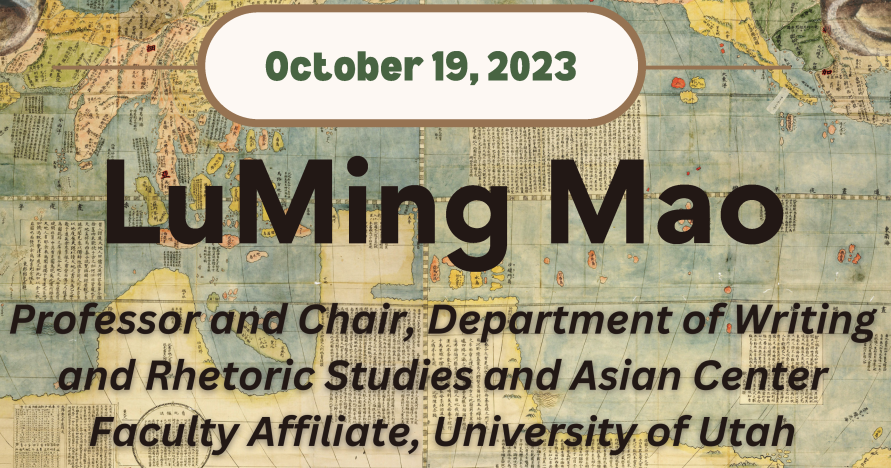
LuMing Mao: "The Ricci Method: Mapping a World as Rhetorical Togetherness"
This section contains archived content made available for reference, research, or recordkeeping purposes. These materials are not actively maintained and may not meet current accessibility standards, such as WCAG 2.1 Level AA. If you need assistance accessing this content or require an accessible format, please contact sohwebmaster@uci.edu. We are committed to ensuring access for all users and will provide accommodations promptly upon request.
Speaker:
LuMing Mao
Professor and Chair of the Department of Writing and Rhetoric Studies and Asian Center Faculty Affiliate at the University of Utah.
Abstract:
What do we make of Matteo Ricci’s 1602 mappamondo, where he placed China toward the center of the map? Does it exemplify the Ricci Method in that Ricci the cartographer adapted himself to a China-centered configuration of the earth? Could it also mean that Ricci the Jesuit had by 1602 completed a spatial and epistemic break and become a Chinese among the Chinese? Still, could we take this map as an example of Ricci the rhetorician negotiating between accommodation and enculturation, between Confucianism and Western Christendom, and between China and modernity? This talk explores these questions and proposes that Ricci the colonizer enacted a rhetorical togetherness to project a “modern” world, in which he could advance his proselytizing designs to serve his greater Christian Lord of Heaven (天主).