
Social Media Storytellers: Students explore academic freedom at UCI
By Robert Munrayos
Florida banned sociology from its core curriculum at state universities this past March – the latest in a series of legislative moves limiting academic freedom on campuses nationwide. In February, the University of Texas system passed a policy allowing students to graduate without studying “unnecessary controversial subjects” and requiring faculty to disclose their syllabi for state review. Two years ago, Indiana passed similar legislation requiring universities to deny tenure to professors deemed “unlikely to foster a culture of free inquiry, free expression and intellectual diversity,” arguing that professors must follow the state’s guidelines on “subject matter” and “perspectives” taught.
At a moment when debates over speech, expression and intellectual inquiry are reshaping university campuses across the country, UC Irvine’s School of Humanities has launched an innovative undergraduate course that puts students at the center of this conversation. Social Media Storytellers: On Academic Freedom is a deep and collaborative exploration of what academic freedom means today, why it matters and for whom.
Centering students
Conceived by Kelly Anne Brown, Director of Communications for the School of Humanities, and Dean Tyrus Miller, the course responds to a clear gap in how academic freedom is discussed and understood. While universities have long emphasized academic freedom as a principle protecting faculty research and teaching, far less attention has been paid to how undergraduate students experience, interpret and are directly affected by it. Social Media Storytellers puts students at the center of this decades-long discussion, asking them to reflect on their own classroom experiences and navigate real campus debates through a public platform: social media.
Students describe the course as pushing them in ways that go beyond the subject matter itself. Guadalupe Sánchez, a second-year history and English double major, explains: “This class has challenged me to reflect on topics that I already knew a bit about, but it pushed me to be comfortable asking questions and to really take up opportunities to learn.”
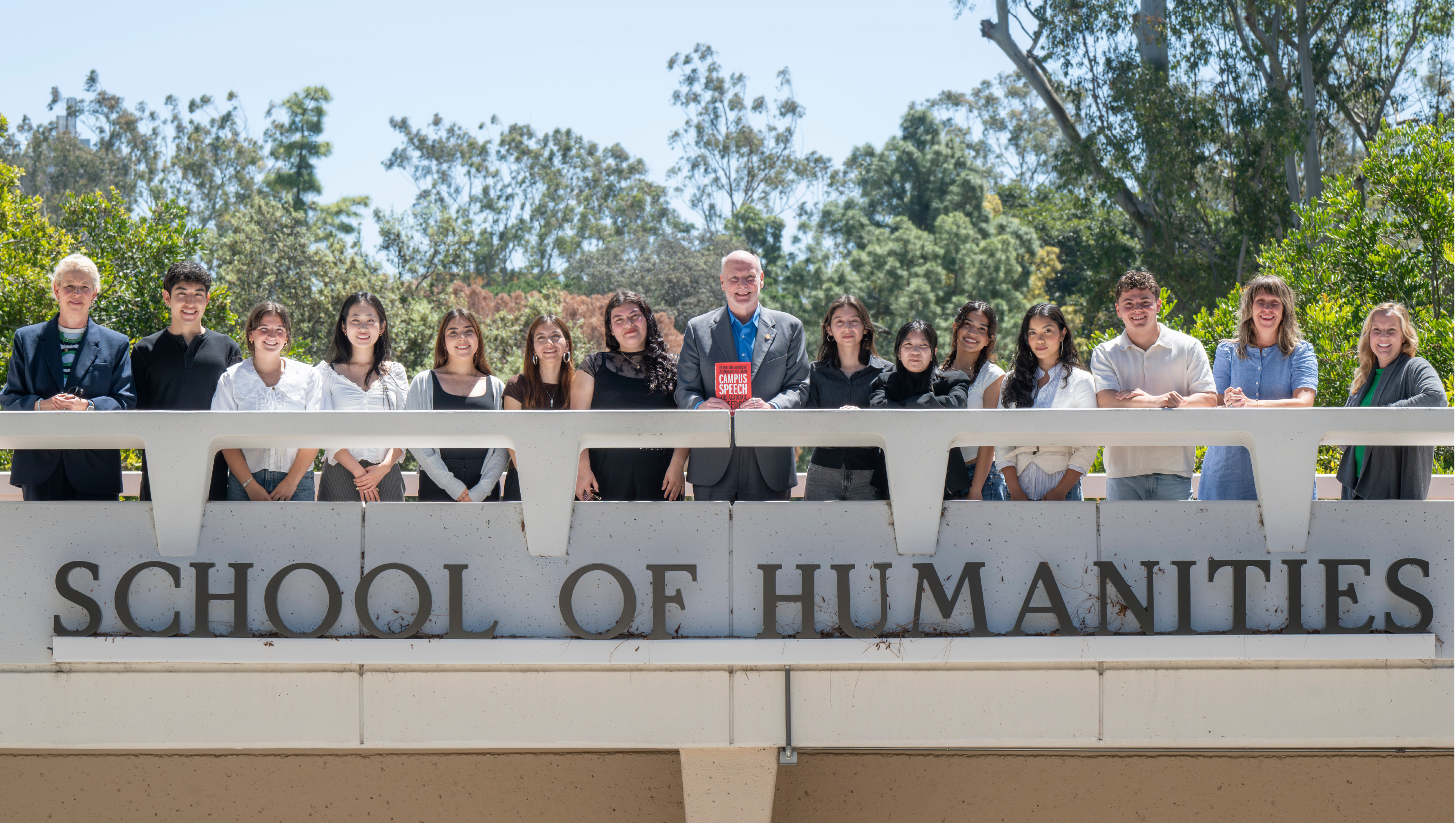
Supported in part by a VOICE grant from the UC National Center for Free Speech, the course engages students in hands-on storytelling about free expression. Fellows conduct interviews, shape narratives and create social media content to share their work with broader audiences. The course launched with a call for proposals in fall 2025, drawing more than 40 applications for five initial spots. This strong interest led Miller and Brown to expand the program to include 12 students across the two-quarter course.
During the winter quarter, fellows met weekly with faculty from across the School of Humanities, including Dean Miller, Professor Jane Newman (comparative literature), Professor Patricia Pierson (literary journalism) and Professor Anke Biendarra (European languages and study). In doing so, students encountered ongoing conversations about how academic freedom is defined across national and institutional contexts. Sessions introduced different dimensions of the topic through multiple disciplinary perspectives, covering topics that spanned from viewpoint diversity to artificial intelligence to the international dimensions of academic freedom.

Academic freedom vs. free speech
Academic freedom refers to the rights and privileges of faculty, as highly qualified experts, to make decisions about how best to educate students and transmit the knowledge of their disciplines without institutional interference. While often conflated with free speech, which allows one to express opinions and ideas free from government censorship and retaliation, the two are distinct. What's more, the line between the two concepts can blur in the context of publicly funded universities.
“The humanities provide a natural space for examining issues like academic freedom because they draw on interdisciplinary ways of thinking and interpreting,” says Dean Miller. “Humanities students are well-equipped to understand the importance of these debates, both generally and for their own learning and academic experience.”

UCI Chancellor Howard Gillman, himself a scholar of constitutional law, joined the class for a session this spring, answering student questions and discussing his recent book, Campus Speech and Academic Freedom (Yale University Press, 2026). Chancellor Gillman’s participation in the course marked the culmination of the students’ exploration of scholarly texts related to the subject. Now students are preparing to take this knowledge and directly address their peers.
Storytelling through social media
A defining feature of the course is its emphasis on social media as a platform for student voices. Discussions move beyond the classroom as students learn to communicate ideas in formats their peers are already consuming, making the work feel both relevant and consequential. “Look – we know that so many of us, and especially our students, use social media platforms in increasingly sophisticated ways,” explains Brown. “We think the impact of humanistic explorations of a topic like academic freedom should absolutely engage with this daily part of students’ lives.”
Alongside academic discussions, students participate in workshops led by communications experts and experienced alumni, building skills on topics like podcasting, video production, social media analytics and the art of writing a strong narrative hook. For Sánchez, thinking about the audience is key to her work. “Creating good social media content requires you to really know your audience, and also to make it accessible on social media by making it approachable, and avoiding too much academic language,” she shares.

Others engage critically with the platform itself. Leisa Komyo, a fourth-year film and media studies and literary journalism double major, considers the potential limitations of social media. “I think social media can be very polarizing and, at times, feel unsafe,” she explains. “The pressure to be concise often comes at the cost of nuance, which can lead to misunderstandings or oversimplified takes.” The course encourages students to sit with this tension, balancing creativity with accuracy, engagement with responsibility and accessibility with complexity.
This spring, fellows are developing and producing original media projects including short videos, interviews, graphic illustrations, visual essays and “person-on-the-street” style conversations with peers. The School will share these works across its social media platforms beginning this spring and continuing into the fall.
Building community and looking ahead
Beyond intellectual exploration, the course fosters collaboration and professional development. Students work collaboratively to create social media projects and participate in regular feedback sessions on one another’s work. Building a community of scholars engaged in the topic is important to both Brown and Miller, who emphasize the networking element of the fellowship. Weekly sessions, team projects and school-wide events create strong connections with faculty, staff, alumni and peers similarly invested in academic freedom.

As a pilot program, Social Media Storytellers is a testing ground for all that student-centered, multimedia approaches can accomplish. By amplifying undergraduate voices on a topic that directly affects their academic lives, the class invites the broader community to consider how academic freedom is experienced and why it matters. Students will complete the course with both a deeper understanding of this question and practical skills in storytelling, digital media and public engagement – all skills that will serve them well beyond the classroom.
Robert Munrayos is a second-year Ph.D. student in UC Irvine’s Department of Latin American and Iberian Cultures. His research explores the intersections of science fiction, gothic literature, indigenous studies and queer studies, with a particular focus on how these genres envision futurity, the posthuman and alternative conceptions of identity. He is especially interested in how speculative storytelling challenges cultural norms and expands the possibilities for collective imagination and social transformation.
Interested in reading more from the School of Humanities? Sign up for our monthly newsletter to read more.