
Revisiting an age of natural history
By Staff Writer
In August 1816, a small ship called the Rurik set out from St. Petersburg. Sponsored by a Russian financier, it aimed to locate a route from the Pacific Ocean to the Atlantic. That elusive route, known as the Northern Passage, was one of the last remaining geographic mysteries of the globe.

This voyage is the subject of UC Irvine historian David Igler’s new book, All Species of Knowledge: A Voyage of Discovery, Failure, and Natural History in the Pacific Ocean (Oxford University Press, 2026). Although (spoiler alert) the explorers did not manage to find the Northern Passage, the expedition was hardly a failure. Its “motley crew,” in Igler’s words, returned with significant new knowledge, which was then widely disseminated. The book brings to life this exhilarating era of discovery, and investigates how knowledge was produced and circulated at the time.
Fascinating characters
Igler’s new book grew out of his previous volume, The Great Ocean: Pacific Worlds from Captain Cook to the Gold Rush, published in 2013. In the course of his research for that project, he encountered several historical figures who captivated him.
Two of them were naturalists: the French-German Adelbert von Chamisso and the Estonian Johann Eschscholtz. Their role on the Rurik was to study the plants and animals they encountered along the way, as well as the geology, weather and other natural phenomena. Between destinations, they would contemplate their observations and develop theories. “They have a lot of time to think, which may be a distinct characteristic for these oceanic naturalists,” Igler notes.
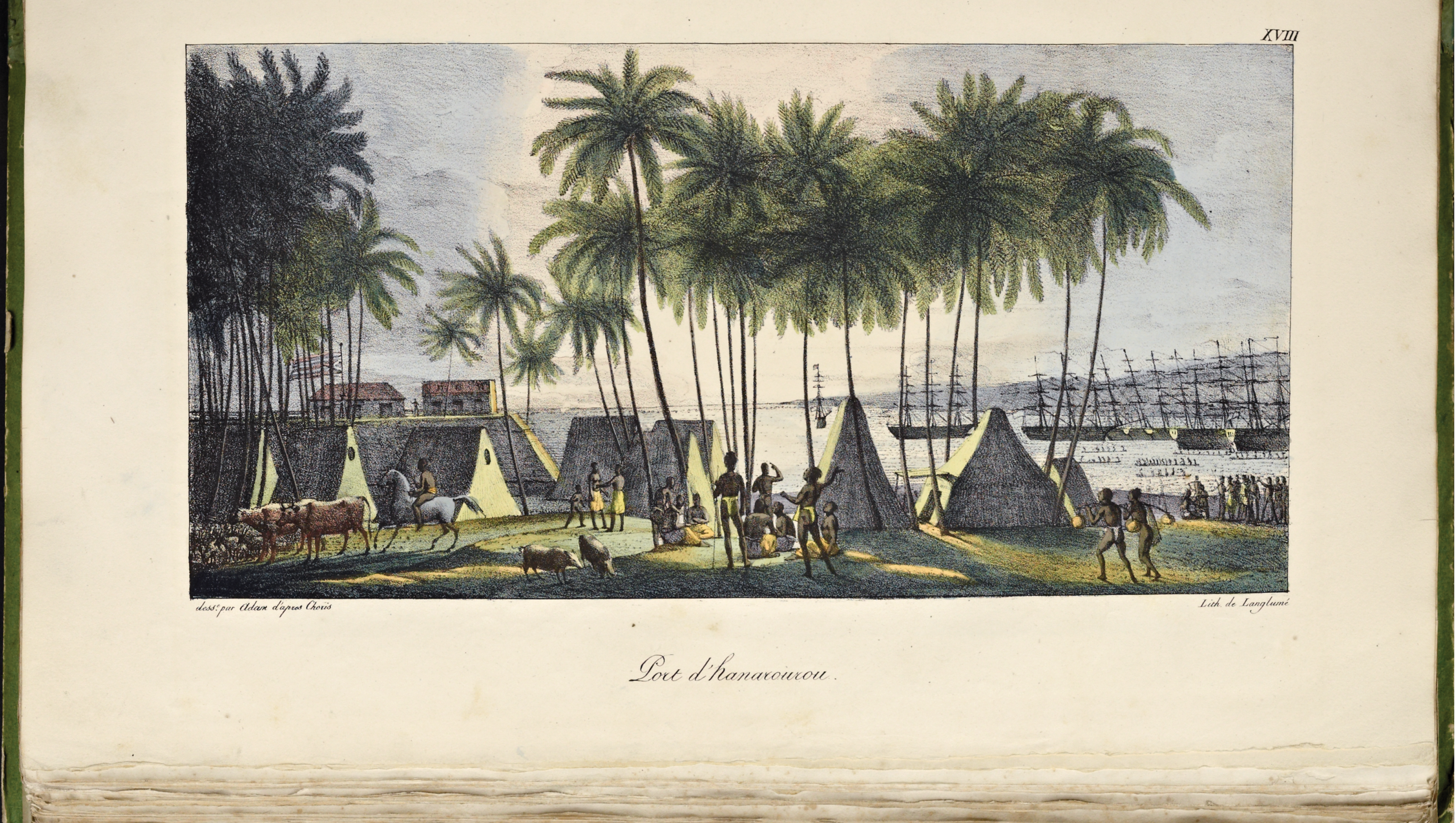
Also on board was a Ukrainian artist, Ludwig York Choris. In the days before photography, “voyages of discovery required a visual record of people and places, flora and fauna, coastal views and geological wonders,” Igler writes. When, early in his research, Igler found a book of Choris’s hand-painted, watercolor lithographs at an archive in New Zealand, “it just blew me away,” he recalls. “That kind of started my hunt.”
Then there was Kadu, a man from the Caroline Islands who joined the voyage more than a year after it began, when the ship stopped in the Marshall Islands. “I think more than anyone it was Kadu that fascinated me,” Igler reflects. While sometimes such voyages had Indigenous people on board, they were typically there to provide various sorts of menial labor, often involuntarily. Kadu, by contrast, seemed to be driven by the impulse to explore the world. Igler adds, “It’s very uncommon for a Pacific Islander to simply say, ‘I’m joining your voyage. Let’s go.’”
Kadu contributed translation and navigational skills. But, Igler says, the captain of the ship also recognized something else in Kadu. “That he’s personable, he’s very outgoing, he’s not in any way afraid of this European vessel or the people on it. So that captain is every bit as intrigued by Kadu as Kadu is by these Europeans.”
Aboard the Rurik
Igler paints a vivid picture of life on board the vessel. Sailors slept on hammocks below decks. The professional personnel — the captain, the naturalists, the artist — shared cabins. There were at least five different languages spoken on deck, but everyone managed somehow to communicate. Between meals, a long dining table doubled as a “makeshift laboratory” where the naturalists would examine their specimens.
One of Igler’s goals was to revisit the heyday of natural history. That term, like “naturalist,” now sounds somewhat dated. “What it suggests,” Igler explains, “is a more integrated science, a kind of open-ended science that is pursuing big questions and thinking about the natural world.” He adds, “This is Darwin’s background.”

The voyage took place as natural history was beginning to splinter into more specialized disciplines. Later, some specialists would “look back at the naturalists and kind of laugh at them, because they were trying to study birds and earthquakes and volcanos all at the same time,” says Igler. “But they were doing that because these were the things that intrigued them. At their best, they were a very curious group whose curiosity resulted in some phenomenal discoveries.”
For example, the naturalists on the Rurik pulled a variety of creatures from the sea. One of them, called a salp, was quite strange — gelatinous and translucent. After extensive observation, Chamisso noticed that it appeared to change form in surprising ways. Chamisso wrote: “It is as if the caterpillar bore the butterfly and the butterfly then in turn bored the caterpillar.” He developed a theory he called “alternation of generation of species,” positing that a species can take a different form from one generation to the next and then switch again.
Igler expresses deep admiration for the passion of these European naturalists. “I mean, they’re total nerds of natural history,” he says. But he takes pains to emphasize that a great deal of what they learned came directly from Indigenous people. “Part of their research was interacting with as many Indigenous people as they could in order to soak up their knowledge,” he says. For example, Chamisso’s study of Northern Pacific whales was entirely based on information conveyed by hunters from the Aleutian Islands, located between the North Pacific Ocean and the Bering Sea.
The “afterlife” of the voyage
The ship returned, after three years, to St. Petersburg. The personnel had to report the disappointing news that they had failed to locate the Northern Passage. But they immediately began to disseminate the other knowledge they had acquired.
“The afterlife of the voyage is in some ways the most important part,” Igler says. “It’s when they are processing all that information and presenting it to the public, whether it’s an academic learned public or the popular press of the early 1800s.”
Chamisso published his theory of alternation of generation of species, based on his observations of the salps. It sounded outlandish and was met largely with derision. But a couple of decades later, he was vindicated when a group of other scientists verified the phenomenon, renaming it “metagenesis.”
To conduct his research, Igler visited libraries and archives in London, Finland, Alaska and Hawaii. Between the publications by the artist and the naturalists, and other contemporaneous writing, there was an enormous amount of available material. “The primary source material for me was just really fabulous stuff to work with,” Igler notes.
What’s next

In addition to his scholarship, Igler will be teaching a writing class in the spring quarter called “Personal Histories,” in which students learn methods to focus on individuals as historical actors. He will also teach "California History," a course he’s offered many times that looks at California from a global, national and local perspective. It includes an extra-credit cooking assignment “that most students get really jazzed about,” Igler says.
Before he turned his attention to the Pacific Ocean, Igler was a historian of the American West. Now, with his next project, he’s returning to land. He is studying an 1841 expedition from the Columbia River, in the Pacific Northwest, to the San Francisco Bay, well before the Gold Rush. It was the first such trip led by representatives of the U.S. federal government: “the advance guard of the US empire,” Igler says. And as with his studies of the Rurik, he is exploring its underappreciated significance. On this trip, too, naturalists interacted with Indigenous people they met and gained knowledge from them.
As for his current book, Igler hopes readers will take from it a new understanding of how Western European scientific knowledge in this period was produced. “It’s not coming out of Paris, London, St. Petersburg labs,” he says. “It’s coming from exploration of the world. It’s non-Western in its origin, and a whole lot of that knowledge is being transmitted from Indigenous people to these traveling naturalists.”
Interested in reading more from the School of Humanities? Sign up for our monthly newsletter.