
The AAPI women behind the National Women’s Conference
By Nikki Babri
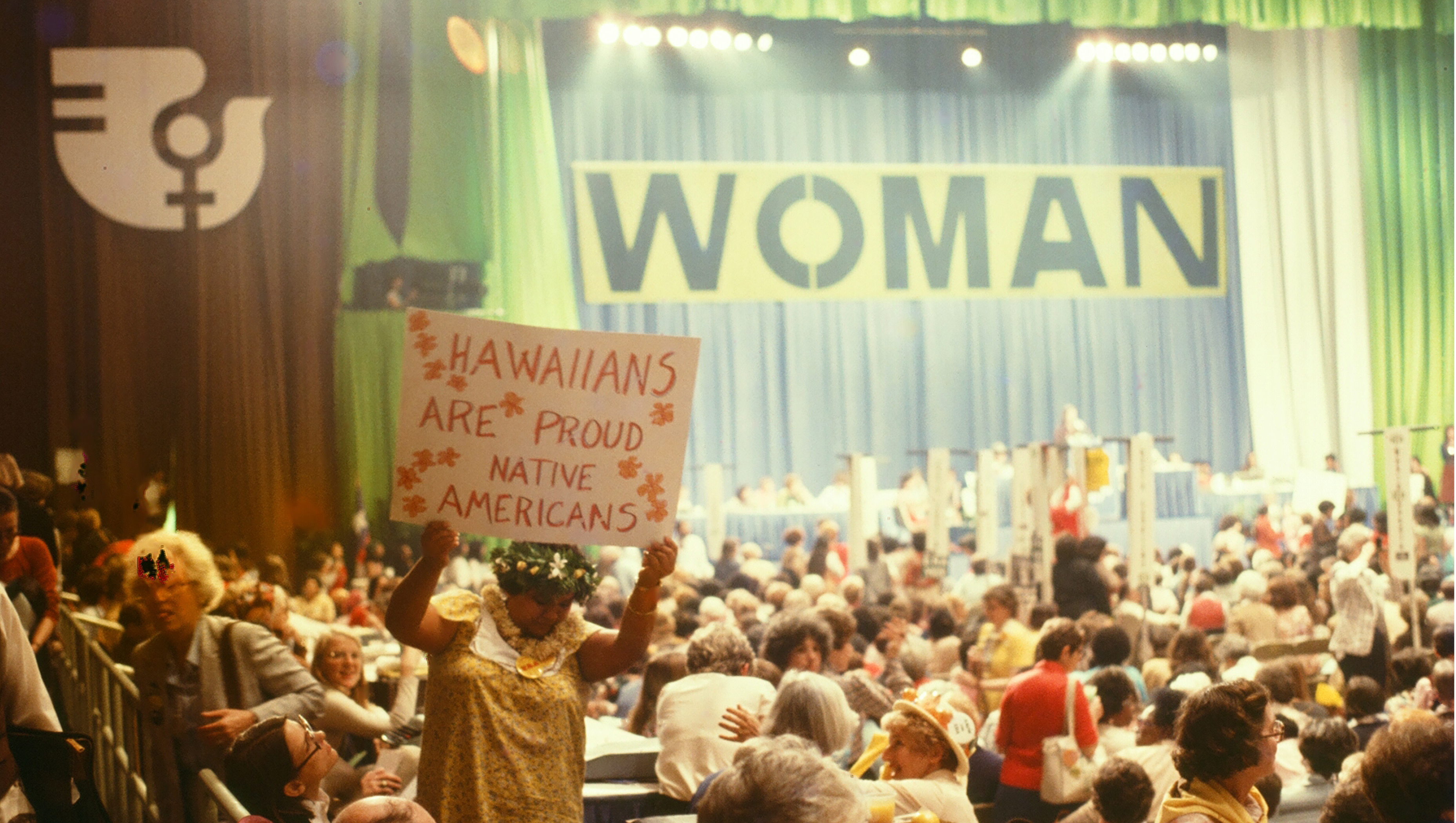
Feminist activist Gloria Steinem called the 1977 National Women’s Conference “the most important event nobody knows about.” Over 20,000 participants gathered in Houston that November from across the United States and 56 countries worldwide. Among the approximately 2,000 delegates were over 80 Asian American (AA) and Pacific Islander (PI) women.

In the fifty years since, these figures have remained largely invisible in the historical record. Chancellor’s Professor of History and Asian American Studies Judy Tzu-Chun Wu wants to change that.
Her new book, Moving Mountains: Asian American and Pacific Islander Feminisms and the 1977 National Women’s Conference (University of Washington Press, 2026), centers these women as principal actors in one of the most consequential moments in American feminist history. Co-authored with Adrienne A. Winans, the book is the first scholarly work to focus on AA and PI women’s involvement in both the 1977 conference and a follow-up series of gatherings held in 1980.
“My focus on Asian Americans and Pacific Islanders foregrounds women who tend to be overlooked in stories about ‘American’ women and even ‘women of color,’” Wu explains. “This is due to their marginalized status as ‘foreigners’ or as Indigenous peoples far from the continental U.S.”
A conference and a movement
The National Women’s Conference (NWC) was the first (and only) time the U.S. federal government funded a national women’s agenda. Composed of a nationwide series of meetings held in every state and territory of the U.S., it was designed to promote grassroots conversations that would result in a national platform. Women of color made up over a third of all delegates – and it was there, in Houston, that historians say the phrase “women of color” was coined.
The book highlights two women in particular. The first is Patsy Takemoto Mink, a third-generation Japanese American from Hawai’i who became the first woman of color elected to the U.S. Congress. Mink was also the namesake for Title IX, the landmark legislation mandating gender equity in schools receiving federal funding.
Wu had been researching Mink’s life when she was introduced to the full scope of the NWC. “I knew that Mink had also supported the conference, but I did not yet know much about it. I came back from a 2017 National Endowment for the Humanities seminar on the NWC with great curiosity about the thousands of women who participated,” she shares.
Wu quickly discovered the full extent of Mink’s role. Along with cosponsoring the bill authorizing the NWC and giving its keynote address, Mink also introduced the Women’s Educational Equity Act, which funded the 1980 follow-up conferences and provided resources to enable curricular change to advance gender equity in schools.
Yet Mink remains underrecognized. “Asian American women are seldom recognized as political leaders. They tend to be racialized and sexualized as exotic and submissive,” Wu explains. “Mink was involved in mainstream politics, even though she collaborated with grassroots political movements. So, she falls out of how most Americans and most scholars think of ‘politics’ and ‘grassroots’ activism.”
The second figure is poet and activist Mitsuye Yamada, who attended both the 1977 and 1980 conferences and whose essays on Asian American feminism were later featured in This Bridge Called My Back: Writings by Radical Women of Color – widely considered “one of the most important collections on women of color feminism” ever published. Yamada, now over 100 years old, lives in a neighborhood adjacent to the UCI campus, a reminder that this history is not as distant as it might seem.
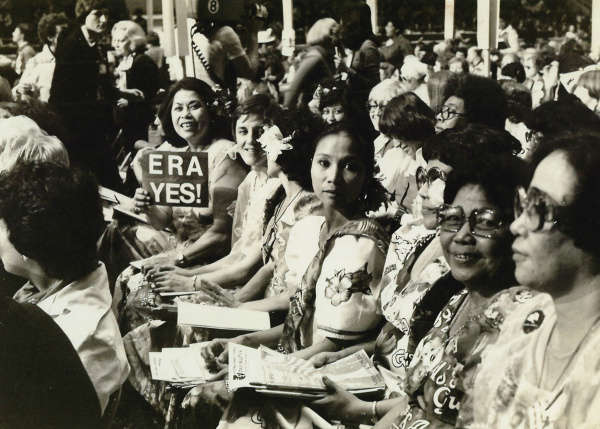
Personal photograph. Permission granted by Gregoria Baty Smith.
Carving distinct identities
Though often grouped together under a single government category, Asian Americans and Pacific Islanders represent distinct communities with distinct histories. Asian Americans are immigrants, refugees or U.S.-born descendants; Pacific Islanders include Indigenous peoples from the islands of Hawai’i, Samoa, Guam and the “Trust Territories.” Their political goals can diverge sharply, with some Asian Americans seeking full equality in the U.S. while Pacific Islanders were more likely to demand sovereignty from it.
“Asian Americans as arrivants to the U.S. have been criticized for contributing to settler colonial processes by Indigenous peoples, like Pacific Islanders,” Wu says. Yet the conferences offer a rare window into how these two groups worked together. Under one roof, they negotiated issues from labor rights and bilingual education to reproductive politics and Indigenous sovereignty.
Three years after Houston, those networks gave rise to the first national Asian Pacific American Women’s Conference (APAWC), held in Washington, D.C., following regional gatherings in California, Hawai’i and New York. One of Moving Mountains’s most significant arguments is its challenge to the prevailing narrative that the era of movement activism effectively ended by the mid-to-late 1970s. Wu sees a different story.
“The late 1970s has been predominantly perceived as a time of decline in activism, but it was a vibrant time of exploration and visioning,” she explains. Despite the rise of conservatism and neoliberal policies beginning to reshape American life during this time, the AA and PI women who emerged as leaders through the NWC and APAWC created lasting networks, wrote foundational texts and laid the groundwork for decades of feminist theorizing and organizing.
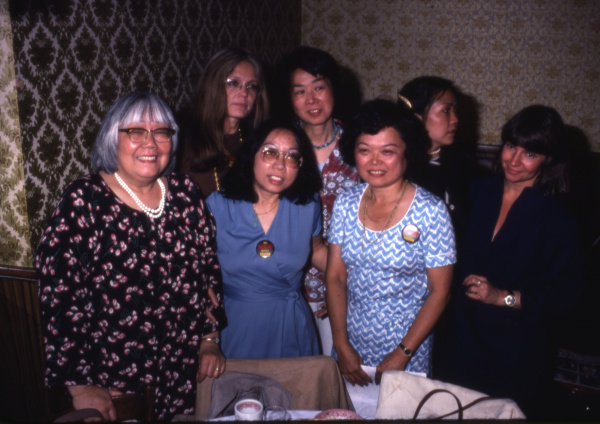
Courtesy of Tamiment Library & Robert F. Wagner Labor Archives, NYU Special Collections. Photo Credit: Ginger Chih.
Research as collective practice
The making of Moving Mountains mirrors the spirit of the grassroots activism it documents. Wu created the book through a large collaborative research effort involving undergraduate and graduate students from multiple UC campuses (Irvine, Santa Barbara, Davis and San Diego) as well as California State University, Sacramento.
“Humanities research tends to be a solo endeavor, so it was wonderful to work on this collectively,” Wu reflects. “It’s rewarding to work together, emulating how the women from 1977 did so to craft a national women’s agenda.”
Together, Wu and the students combed through archival sources, print materials, digital records and conducted oral histories with participants and their families. The students’ research contributed to a digital humanities initiative called “Sharing Stories from 1977,” led by the University of Houston, which is working to document the entirety of the NWC. The students based in California created their own website, “Nothing Less than Justice.” Additionally, an essay co-authored by Wu and graduate students Stephanie Narrow ‘23 (Ph.D. history) and Haleigh Marcello ‘26 (Ph.D. history) that focused on the California delegation received the Richard J. Orsi Prize for Best Article published in California History in 2023.
Some of the most affecting parts of the research came through oral history interviews, which Wu describes as far more personal and intimate than archival work. She recalls a conversation with a woman who had been involved in the Third World Liberation Front in the late 1960s. A decade later, the woman was working inside the federal government on civil rights and helping administer the U.S. census. Wu asked how she understood that shift from outsider to insider.
“She shared that she thought of the U.S. as a revolutionary project – the nation had been born out of revolution, and she believed it could be transformed to more fully realize the goal of democracy,” Wu recalls. “I thought this insight helped capture the hopes and goals of the women who participated in a state-supported project, the National Women’s Conference, and yet also wanted to push their society more towards the direction of equal inclusion.”
Looking to future generations

Wu is already at work on her next project: a biography of Edith Yang, a third-generation Chinese American and the first woman of color architect licensed in the state of Oregon. “She was on the organizing committee for Oregon in 1977’s NWC, which is how I became interested in her,” Wu explains. The book will explore Yang’s life and career, and her efforts to advocate for environmental issues and accessibility in architecture and design.
The throughline connecting past and present is never far from Wu’s mind. The racialized and sexualized assumptions that shaped the experiences of AA and PI women in the 1970s have not disappeared. Instead, they’ve resurfaced, most recently in the surge of anti-Asian hate during the COVID-19 pandemic.
“The issues of the 1970s continue to be present in the 21st century. These presumptions have a long history in the U.S. and sadly reside in the cultural psyches of our society,” Wu says. “I hope a book on activism and feminisms will inspire current and future generations to ask questions, to see possibilities and to find ways to collectively organize to bring these into fruition.”
Interested in reading more from the School of Humanities? Sign up for our monthly newsletter to read more.
(Main image: A view of the convention and an assertion of Indigenous rights. Personal photograph. Permission granted by Gregoria Baty Smith.)