
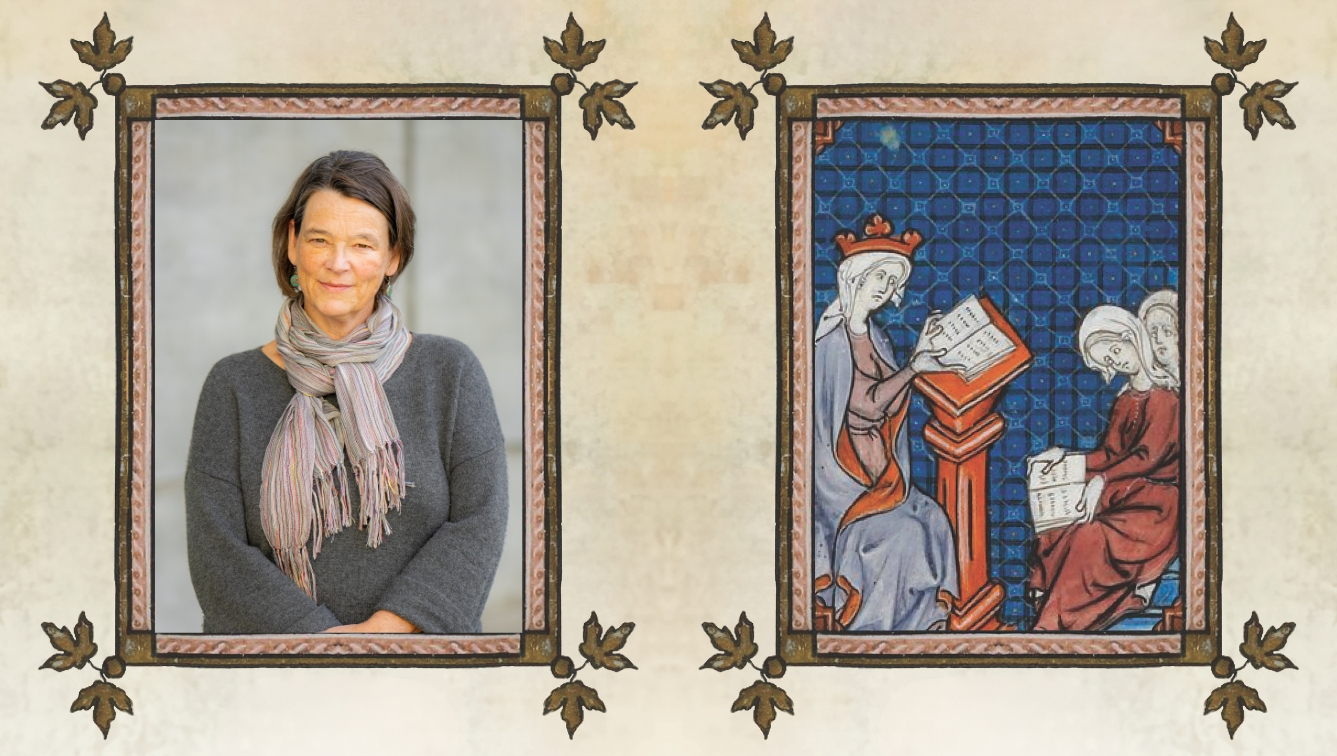
Q&A with medieval literature scholar Elizabeth Allen
In times of social or political crisis, language itself becomes contested territory. Hundreds of years ago, as England grappled with plague, uprisings and royal tyranny, even ordinary words for gathering and assembly took on dangerous new meanings. Medieval poets like Geoffrey Chaucer, for example, recognized this power and used it to imagine alternative forms of community and resistance.
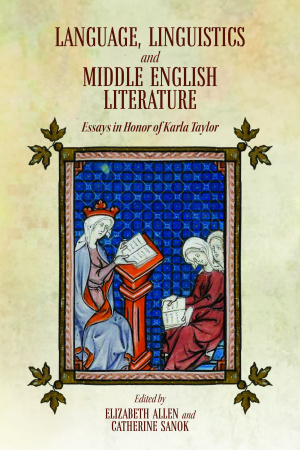
UC Irvine Professor of English Elizabeth Allen uncovers these dynamics with co-editor Catherine Sanok in the book of essays, Language, Linguistics and Middle English Literature: Essays in Honor of Karla Taylor (D.S.Brewer, 2025). The collection brings together work by the former students of medieval literary scholar Karla Taylor and explores how writers used the intricacies of Middle English – from word choice to rhyme patterns – to navigate larger questions of authority, gender and social change.
For readers who associate medieval literature with dusty manuscripts and archaic language, what would you say makes these 600-year-old texts feel alive and relevant today?
Reading the literature of writers like Chaucer and Dante is like time travel in science fiction: you get to experience another world. That world feels alive because it is so alien. It’s a world where – for example – people went on pilgrimage to shrines and literally crawled underneath the dead bodies of saints in hopes of being healed. It’s a world where, if you committed a murder, you could run to the nearest church, avoid trial, and go into exile. It’s a world of stories in which an exiled prince wears the skin of a wolf to travel in disguise, a ghost pays off the debts of a living knight, and a blessed king dies at the hand of his own son.
But the world of medieval literature also feels alive because of its connections to the present day. Medieval literature responds to social and political crises that resonate with our present day experiences: the Middle Ages experienced its own pandemic, the Black Plague, and its own forms of political control, when the leaders of the Uprising of 1381 were tried and executed. There were labor shortages that led to laws suppressing wages and laborers who flouted those laws. There were terrible inequities in the treatment of serfs, vagrants, the mentally and physically disabled; there were restrictions on women’s legal rights while there were also unusual opportunities for female independence. The social world of medieval literature is immensely various, lively, and resonant to this day.
What makes medieval literature particularly suited to examining questions of power and resistance? What can medieval linguistic conflicts teach us about our current moment?
Colette Moore writes in her essay in the book that words for political gatherings were in great flux in late medieval England. During this period, England underwent severe socio-policial crises: the plague wiped out up to half the population, labor unrest erupted, a heretical group called the Lollards criticized the Catholic church and translated the Bible into English. Meanwhile King Richard II was an increasingly embattled, tyrannical, and vengeful king, and he was eventually deposed. Words like “coven,” “congregation,” and “company” became highly charged; Moore argues that Chaucer’s poetry creates new connotations for words of civic gathering.
This kind of thing is happening today as well: the political instability of our country has changed the meaning of some words and added extra charge to others (think of shifting uses of words like “woke” or “antifa”). The President’s social media habits have affected the tone and vocabulary of many posts on social media. These linguistic developments cannot be separated from the social and political realities people face, then and now.
That said, there are very real differences between then and now – and this fact liberates us to examine the relation between words and the social world in a kind of safe zone of the past. Thinking about a 600-year-old text, we are free to experiment in our minds with material that was highly charged or dangerous to people back then. We might be freed up to find Chaucer’s Reeve both class-oppressed and, finally, morally repellent; or to find social protest in Chaucer’s rhymes.
What first drew you to Karla Taylor’s work, and why did you decide to organize this collection in her honor? How has Taylor’s influence shaped your own scholarly methodology?
Karla Taylor’s work is obsessed with power dynamics between medieval authors and their readers – how authors cannot control their readers, how readers sometimes influence authors. At the same time, Taylor is a true believer in the social and political power of language, and I learned from her both how to observe the surfaces of language and how to pay attention to its function in the world. She would say that I learned from her how to practice philology – an often loosely-defined practice of close attention to the historical uses of words.
Taylor introduced me to medieval literature when I was an undergraduate at Yale in 1986, advised my thesis there, and supervised my dissertation at the University of Michigan when I finally went back to school. This book of essays by Taylor’s students honors lifelong scholarly relationships and pays tribute to an immensely gifted reader and teacher. It is a festschrift, that is, a book of celebration-writing, that calls renewed attention to a scholar whose work has remarkable endurance and unusual currency in the present moment.
The book positions philology as relevant to contemporary scholarly debates about surface reading and historicism. What makes Taylor’s approach feel current today and why do you think it’s important for modern readers to engage with medieval literature through this philological approach?
Medieval studies has always been more “philological” than many other literary fields – more interested in language and its history. This is because, when we study such unfamiliar literature, we are forced to pay attention to radically unfamiliar words, linguistic patterns, literary genres, and social contexts. Philology has recently come under criticism for being structured by racist, nationalist agendas of the 19th century. But philology is a method that can be used for different ends; we do not have to embrace racist or nationalist agendas just because we are looking closely at language.
Instead, philology can help defamiliarize the assumptions we make about literary form and language. It forces us to observe, to seek recognition, to embrace surprise, to examine what we find absorbing about anything we read.
Your chapter focuses on a moment of profound grief in Troilus and Criseyde. What draws you personally to scenes of emotional extremity in medieval texts?
I tend to be drawn to moments when stories come to a halt, when they get stuck, when there is some kind of temporal or spatial stasis. Often this is a moment when an allusion or metaphor – some kind of overtly literary figure – seems to overburden or disrupt its narrative context. Here, the lovers Troilus and Criseyde have just learned that she is to be traded to the Greeks and they are to be separated forever. They mutely embrace, Chaucer writes, as miserable as the ancient princess Myrrha, who seduced her father and was turned into the myrrh tree. The allusion is awkward and dense and very elliptical – you have to make your way through enjambed lines and repetitive sentence structures and footnotes to figure out what the reference is – and that kind of puzzle appeals to me. I read very slowly, and so when the narrative is inviting me to read slowly, I think it makes me feel validated! But such density also allows me to linger in the emotional turmoil of the moment in a way that may be vicarious, like any act of reading, but feels both beautiful and poignant.
Interested in reading more from the School of Humanities? Sign up for our monthly newsletter.